How to Loop a PowerPoint Slideshow

To loop a PowerPoint presentation, navigate to Slide Show > Set Up Slide Show and check “Loop continuously until ‘Esc’”, or configure timed auto-advance under Transitions to run a self-playing slide deck.
TL;DR
- The Fast Answer: Loop Continuously Until Esc: The rapid 4-step shortcut to set your slides on infinite repeat using native ribbon settings in under 60 seconds.
- Set Up Slide Show: Step-by-Step With Exact Menu Labels: Exact dialog controls, speaker vs. kiosk mode trade-offs, and the essential pre-flight test to verify your loop before live audiences.
- Add Automatic Slide Timing (No Clicking Required): How to configure advance timers and dial in granular, per-slide durations so your presentation runs hands-free without a laptop babysitter.
- Loop Continuously vs. Kiosk Mode vs. Timed Auto-Advance: A side-by-side comparison matrix breaking down navigation locks, exit keys, and which playback mode fits your event setup.
- How to Loop Only Part of a Presentation: Isolate and cycle a specific subset of slides, like a customer showcase or product reel, without hacking up your master file.
- Gotchas: Video, Audio, and PowerPoint Online Limits: Proven workarounds for clipped background audio tracks, video sync mismatches, and web browser feature gaps.
- When Not to Loop Your Presentation: The honest reasons to skip unattended looping entirely for confidential NDA metrics, dense data tables, and live sales discussions.
- PowerPoint Looping FAQ: Quick-fire answers tackling infinite loops, keyboardless touchscreen navigation, and halting endless slide cycles on command.
- Build a Self-Running Deck That Holds Up on Repeat: How 24Slides' dedicated designers engineer kiosk-ready presentations tailored for walk-by engagement rather than retrofitting speaker decks.
Ever found yourself stuck manning a trade show booth in Lima, wondering how to loop a PowerPoint presentation so you can finally step away for a quick cafecito? Whether you are setting up a digital menu, an office lobby display, or a hands-free event screen, getting your slides to play on repeat is an absolute lifesaver. If you've been frantically Googling "how do I get a PowerPoint presentation to loop," take a breath; you are exactly where you need to be!
The Fast Answer: Loop Continuously Until Esc
If you are on a tight deadline, here is the absolute fastest way to solve the "how to loop a PPT slide show" puzzle:
- Navigate to the Slide Show tab on your top ribbon.
- Click Set Up Slide Show.
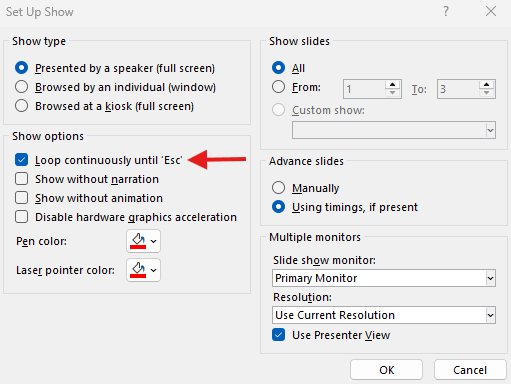
- Under the Show options section, check the box that says Loop continuously until 'Esc'.
- Click OK, then press F5 to launch.
That’s it! Your presentation will now repeat from slide one the second it ends, looping seamlessly until someone taps the Escape key.
Best of all? This setting is persistent. Once you save the presentation, the loop setting travels with the file, meaning it will play perfectly on repeat the next time it's opened on any machine.
More Than Presentations
One Design Partner
From infographics and reports to full marketing collateral, built on demand.
Set Up Slide Show: Step-by-Step With Exact Menu Labels
Mastering how to loop a slideshow in PowerPoint boils down to navigating one single dialog box. Follow these exact ribbon commands to ensure your settings save properly the first time.
Enable Continuous Looping
When learning how to loop slides in PowerPoint, you don't need macros or third-party add-ins, just Microsoft's built-in dialog controls:
- Click the Slide Show tab in the main PowerPoint ribbon at the top of your screen.
- In the Set Up group, click the Set Up Slide Show button.
- Locate the Show options section in the middle of the pop-up window.
- Check the box labeled Loop continuously until 'Esc'.
- Click OK to lock in your changes.

Choose Your Show Type
In that very same dialog box, look at the top left under Show type. When determining how to make a PowerPoint loop, you have two distinct operational modes:
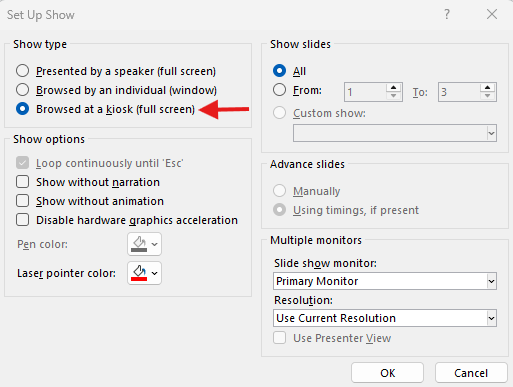
- Presented by a speaker (full screen): This is PowerPoint's default setting. Your slides loop back to the beginning after the finale, but you retain full manual control using your keyboard arrows, mouse, or presenter clicker.
- Browsed at a kiosk (full screen): Here is the massive "gotcha" most basic tutorials leave out: selecting Kiosk mode auto-enables looping, but it completely disables mouse clicks and arrow keys for slide navigation. If an attendee taps the screen or hits the spacebar, nothing moves. The presentation will only advance if you have configured automatic slide timings or programmed clickable action buttons.
If you're running an unattended digital booth from Miraflores to Manhattan, Kiosk mode prevents passersby from accidentally closing or skipping your deck, but it will sit frozen on slide one if your automated transitions aren't configured!
Test the Loop Before Presenting
Once you understand how to get a PowerPoint to loop, never trust your settings on faith right before a live event. Always run this verification test:
- Press F5 (or Fn + F5 on certain laptops) to launch the slide show from the very beginning.
- Allow the presentation to run (or advance manually to your final slide).
- Observe the transition past your last slide: your screen should seamlessly cut right back to slide one, completely bypassing the default black "End of slide show" screen.
- Hit Esc to confirm the deck releases back to normal edit mode.
Add Automatic Slide Timing (No Clicking Required)
Setting up a continuous loop is only half the battle. If you don't assign automatic slide timings, your presentation will just sit frozen on slide one waiting for a manual click. When exploring how to make PowerPoint loop on total autopilot without a human babysitting the laptop, you need to hand over control to the transition clock.
Set the Advance Slide Timer
If every slide in your deck carries roughly the same amount of visual information, applying a uniform timer across the board is your quickest route:
- Navigate to the Transitions tab in the main PowerPoint ribbon.
- On the far right, locate the Advance Slide section.
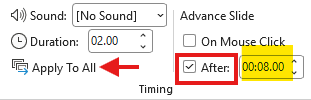
- Uncheck the On Mouse Click box so wandering fingers or accidental bumps can't disrupt playback.
- Check the box next to After.
- Enter your preferred duration in the timer field (for example, 00:08.00 for an eight-second display).
- Click Apply to All to lock that cadence across every slide in your deck
.
A quick technical detail from our 24Slides design team: The "After" input field actually accepts precision timing inputs down to 0.01-second increments (ideal for rapid frame sequences or micro-transitions), but PowerPoint’s UI box visually rounds the display to a single decimal place once you press Enter. Rest assured, your granular sub-second timings remain active behind the scenes!
Set Different Timing Per Slide
Uniform timing works brilliantly for photo carousels, but what if you're wondering how do you loop a PowerPoint that contains wildly uneven content? Giving your audience eight seconds to read a three-word title slide feels agonizingly sluggish, yet giving them that same eight seconds to absorb a dense financial roadmap is an impossible sprint.
To tailor your pacing slide by slide:
- Skip the "Apply to All" command completely.
- Click an individual slide from the left-hand thumbnail panel (do not use Ctrl+A or Cmd+A).
- Assign a custom After duration calibrated strictly to that slide's cognitive load (e.g., 4 seconds for a transition slide, 14 seconds for a comparison chart).
- Repeat this adjustment for each unique slide in your sequence.
Loop Continuously vs. Kiosk Mode vs. Timed Auto-Advance (Comparison Table)
When figuring out how do you loop a PowerPoint presentation, choosing the wrong playback configuration can leave your deck frozen on slide one or vulnerable to wandering hands. If you've been wondering, "how do i loop a powerpoint presentation without running into surprise technical glitches at your next expo?", understanding how native looping, kiosk locks, and transition timers interact is essential.
Here is how the three core playback mechanics compare side by side:
How to Loop Only Part of a Presentation
What if you have a 40-slide pitch deck, but you only want slides 12 through 18, say, a client testimonial reel or a product showcase, to cycle continuously on a booth display while keeping the rest hidden? You don't need to cut up your master file or duplicate slides into a messy "Deck_V2_FINAL_loop.pptx."
Instead, use PowerPoint’s native Custom Slide Show feature to isolate that exact cluster and loop only the slides you need.
Step 1: Build Your Custom Slide Range
- Open your presentation and head to the Slide Show tab on the main ribbon.
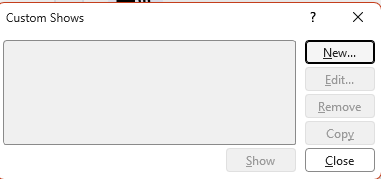
- In the Start Slide Show group, click Custom Slide Show and select Custom Shows... from the dropdown menu.

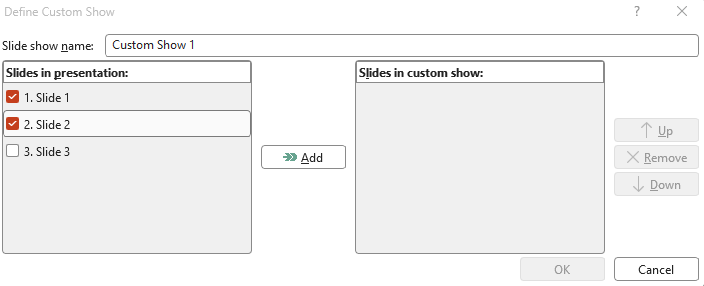
- In the Slide show name field, give your sequence a clear label (e.g., Lobby Reel or Product Loop).
- On the left side (Slides in presentation), check the boxes next to the specific slides you want to feature.
- Click Add >> to shift them into the Slides in custom show panel on the right, reorder them if needed, and click OK
Click the New... button.
Step 2: Lock the Loop to That Specific Range
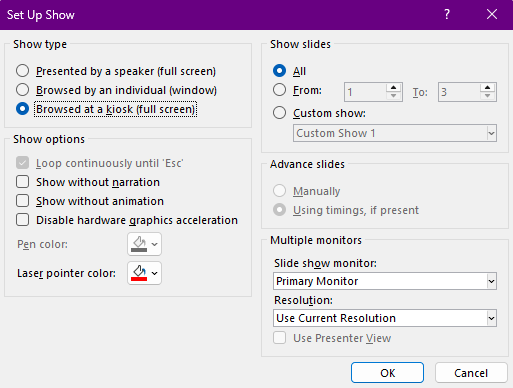
- Still on the Slide Show tab, click Set Up Slide Show.
- Locate the Show slides section on the right side of the window.
- Change the radio button selection from All to Custom show.
- Use the dropdown next to it to pick the custom show you just created.
- Under Show options, check Loop continuously until 'Esc' (or select Kiosk mode under Show type), and click OK.
When you press F5, PowerPoint will ignore every other slide in your file, looping strictly through your designated subset until you hit Escape.
Gotchas: Video, Audio, and PowerPoint Online Limits
Nothing drains the energy from an exhibition booth quite like audio screeching to a halt or an embedded video getting cut off mid-sentence. Before you walk away from your automated display, keep these three media and platform quirks in mind:
1. The PowerPoint for the Web Blindspot
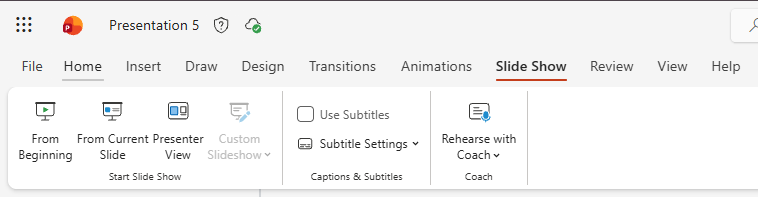
If you are editing in PowerPoint Online via a browser, you won’t find the standard Set Up Slide Show dialog on the ribbon. Microsoft strips out advanced playback configuration in the cloud version, meaning you cannot toggle "Loop continuously until 'Esc'" or activate Kiosk mode natively in your browser tab. To set up an automated loop, click Editing > Open in Desktop App, configure and save your show settings in the full desktop software, and sync the file back to OneDrive.
2. Autoplay Videos & Mismatched Slide Clocks
When your presentation loops back around, any embedded clip set to Start: Automatically reloads and restarts from 0:00 on every cycle. The catch? If your slide transition timer is set to advance after 10 seconds, but your video clip is 25 seconds long, PowerPoint will ruthlessly yank the viewer away mid-playback. To prevent jarring jumps, ensure that slide’s After advance timer matches or slightly exceeds the exact runtime of the video.
3. The "Play Across Slides" Audio Snag
Setting background music to Play across slides (or Play in Background) works smoothly during a standard single run. However, continuous looping treats Slide 1 as a hard reboot. The moment your presentation finishes its final slide and cycles back to the start, the audio track abruptly clips and restarts from the first second. For a smooth audio experience, keep your music files self-contained on specific slides, or route a continuous background playlist through an external media player.
Looping the visuals is only half the battle. If your deck needs an ambient soundtrack to match, head over to our quick guide on how to add music to a PowerPoint presentation so your tunes loop just as cleanly as your slides.
When Not to Loop Your Presentation
Just because you can loop a slide deck doesn't always mean you should. A self-running presentation is fantastic for passive visual engagement, but it introduces some overlooked vulnerabilities
Frequently Asked Questions
How can I loop a PowerPoint Slide Show without clicking?
To achieve a completely hands-free loop, you need two settings: continuous looping and automatic advance timings. Head to Slide Show > Set Up Slide Show and check Loop continuously until 'Esc'. Next, open the Transitions tab, uncheck On Mouse Click, check the box next to After, enter your desired slide duration (e.g., 6 seconds), and click Apply to All. Press F5 to let your deck run hands-free.

How to repeat a presentation?
Open your deck and navigate to the Slide Show tab on the top ribbon. Click Set Up Slide Show, check the box labeled Loop continuously until 'Esc' under Show options, and click OK. Launch your presentation by pressing F5; it will seamlessly repeat from slide 1 after reaching the final slide.
How do I create an infinite loop in PowerPoint?
Under Slide Show > Set Up Slide Show, choose Browsed at a kiosk (full screen) beneath the Show type menu. Kiosk mode turns on continuous looping automatically while disabling standard mouse clicks and keyboard arrows. Pair this with transition timers on every slide (Transitions > Advance Slide > After), and your slides will cycle in an infinite visual loop until someone hits Esc.
How do I make my slides loop?
Click Slide Show > Set Up Slide Show, locate the Show options group, check Loop continuously until 'Esc', and hit OK. Your deck will now restart from the beginning whenever it finishes instead of showing the default black end screen.
Can I loop only a section of slides in the middle of my presentation?
Yes. Go to Slide Show > Custom Slide Show > Custom Shows... and click New. Choose only the specific slides you want to feature, name your sequence, and save it. Then open Set Up Slide Show, choose Custom show under the Show slides section, pick your new subset, and check Loop continuously until 'Esc'.
How do I stop a PowerPoint that is set to loop?
Press the Esc key on your physical keyboard at any point during the show. If you are operating on a touchscreen kiosk without a keyboard attached, press and hold (or right-click) the display surface to reveal the hidden shortcut menu, then tap End Show.
Next Step: Build a Self-Running Deck That Holds Up on Repeat
Turning on continuous looping takes less than a minute, but designing a presentation that genuinely captivates passersby on repeat is a whole different ballgame. As the audio glitches and unreadable data tables above show, an automated loop instantly magnifies every flaw in a deck that wasn't engineered for unattended viewing. Slapping an eight-second timer onto a dense, speaker-led pitch deck only guarantees confused looks and rushed readers.
That is where purpose-built visual storytelling comes in. At 24Slides, our dedicated, brand-trained designers build high-impact trade show loops, lobby screens, and kiosk presentations from the ground up every day. Instead of retrofitting an existing deck, we architect your visual hierarchy, motion cues, and content density specifically for viewers scanning your screen from ten feet away.
Ready to transform passive foot traffic into engaged leads without babysitting a laptop? Partner with 24Slides presentation designers to build an automated deck that runs flawlessly on repeat.
Make Every Important
Presentation Count.
Get reliable, brand-trained design capacity whenever you need it.
Never let internal bottlenecks ruin a high-stakes pitch.