What Is a Pitch Deck? Definition, Purpose, and How to Build One That Works

A pitch deck is a 10–20 slide presentation that summarizes a business idea to persuade an audience, most often investors. It systematically covers the problem, solution, market size, business model, and team.
TL;DR: Executive Summary
- How to Create a Pitch Deck: Winning decks rely on a core narrative covering the problem, solution, product, market size, business model, traction, team, and funding ask.
- What VCs Look For in an Investor Deck: Venture capitalists evaluate decks against four primary viability signals: founder capability, proven demand, market size, and unit economics.
- Pitch Deck Design & Layout Best Practices: High-performing pitch decks rely on intentional visual hierarchy and custom data visualization rather than dense text blocks.
- Pitch Deck vs. Business Plan: A pitch deck is a concise visual hook designed to secure a meeting, whereas a business plan is an exhaustive operational audit.
- Pitch Deck FAQs & Software Tools: Standard tools like PowerPoint work for early outlines, but high-stakes presentations require human design expertise for enterprise polish.
What a Pitch Deck Actually Means (Definition, Purpose, and Where It's Used)
A pitch deck refers to a brief, highly visual slide presentation used to pitch an idea, product, or company to a target audience. If you are stepping into a boardroom, pitching a venture capitalist, or trying to win an enterprise contract, you will inevitably be asked for your deck.
Unlike a comprehensive, text-heavy business plan, a pitch deck relies on concise storytelling and visual hierarchy to communicate complex business models in a fraction of the time. While many associate pitch decks exclusively with startup fundraising, their application across the corporate landscape is much broader. They serve as a foundational tool for modern business communication.
What Is the Purpose of a Pitch Deck?
The purpose of a pitch deck is rarely to close a deal or secure funding on the spot. Instead, a successful pitch deck serves three primary functions:
- Securing the Next Meeting: Captures the audience’s attention and generates enough interest to move to the next stage of the decision-making process (such as a follow-up meeting or a term sheet).
- Informing Decisions: Provides stakeholders with the high-level data and narrative required to evaluate the viability of a proposal.
- Standing In for a Longer Document: Acts as a highly scannable, visual executive summary, standing in for a dense document like a traditional business plan.
What Is a Pitch Deck in Business? (Beyond Startups)
While startups use them to court venture capital, enterprise organizations rely on them daily. Beyond startup fundraising, pitch decks are utilized heavily for non-fundraising business applications:
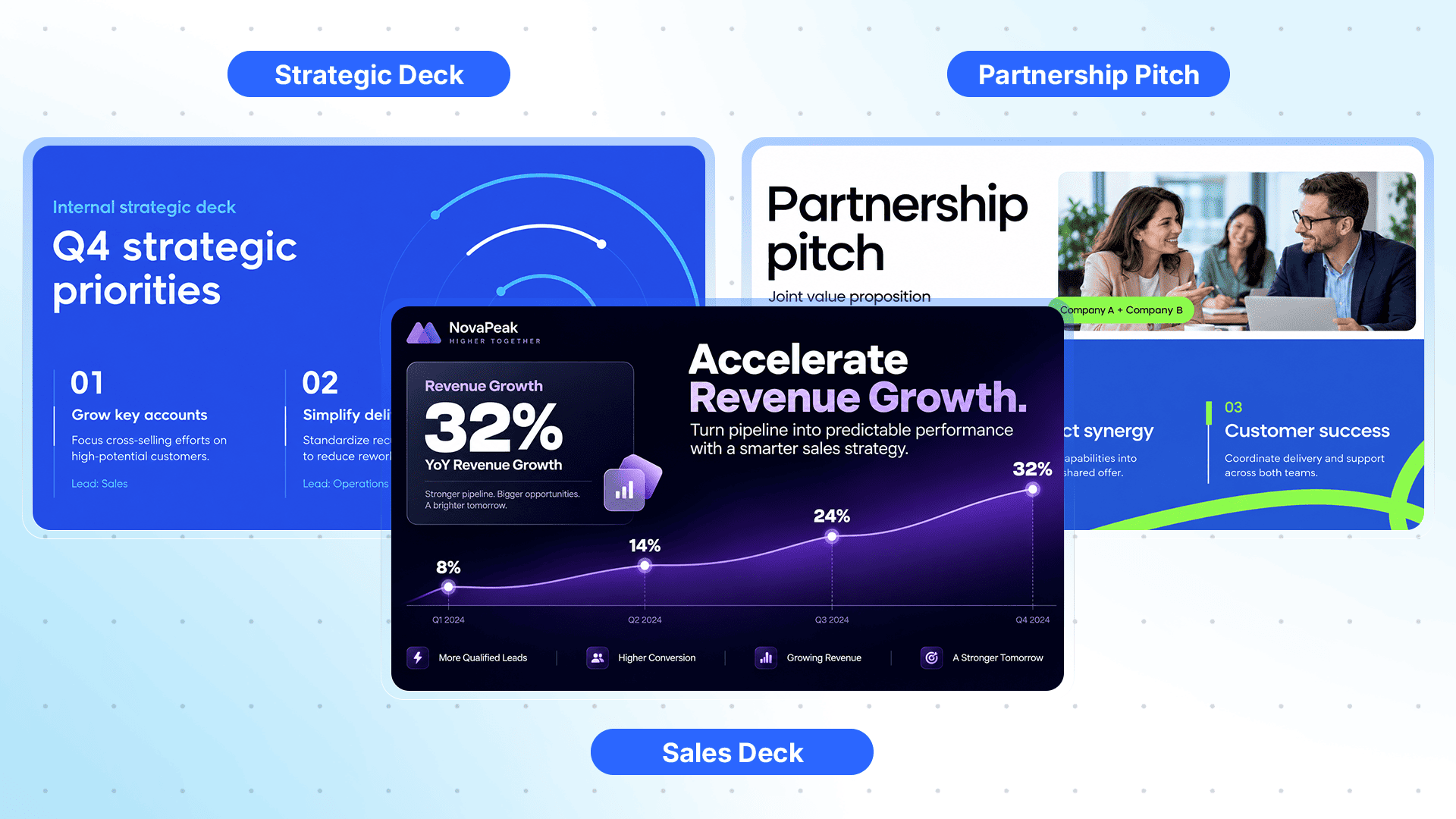
- Sales Decks: Used by B2B sales teams to pitch products or services to prospective enterprise clients.
- Partnership Pitches: Designed to align two organizations for a strategic joint venture, merger, or co-marketing campaign.
- Internal Strategy Decks: Used by executives and agency leaders to propose new internal initiatives, budget approvals, or project expansions to internal stakeholders.
How to Create a Pitch Deck (Structure and Templates)
Creating a high-impact pitch deck requires aligning your narrative with audience intent before opening presentation software. A winning deck balances strategic planning—analyzing your target audience and core purpose—with a clean, logical visual layout.
For an in-depth, step-by-step breakdown on how to structure each phase from audience analysis to final slide polish, read our complete guide on how to build the perfect pitch deck.
The Essential Slides Every Pitch Deck Needs
- Cover: A high-impact title slide with a clear value proposition.
- The Problem: The specific pain point in the market your target audience faces.
- The Solution: Exactly how your product or service resolves that identified problem.
- Market Size: The total addressable market (TAM) proving the opportunity is large enough to matter.
- Business Model: How your company generates revenue.
- Traction: Hard data showing current revenue, user growth, or engagement.
- Team: The expertise of the founders or project leaders.
- The Ask: Explicitly stating what you need (funding, budget, or a contract sign-off).
Free Pitch Deck Templates to Start From
Self-service tools and templates are a great way to draft your initial narrative before moving into formal presentation design.
- Need an investor-ready layout? Try our free startup pitch deck template.
- Pitching a sponsorship or conference? Use our event pitch deck template.
- For a wider variety of corporate formats, you can browse free pitch deck templates in the 24Slides library.
What Is a Pitch Deck for Investors? (Startup Fundraising Angle)
When targeting angel investors or venture capitalists, the expectations for your presentation shift dramatically. An investor-facing deck differs from an internal one by placing heavy emphasis on traction, total addressable market (TAM) size, hard financials, and a clear, justifiable "ask".
Investors review thousands of decks annually and expect concise, data-backed, and highly visual presentations.
What Do Investors Look for in a Pitch Deck?
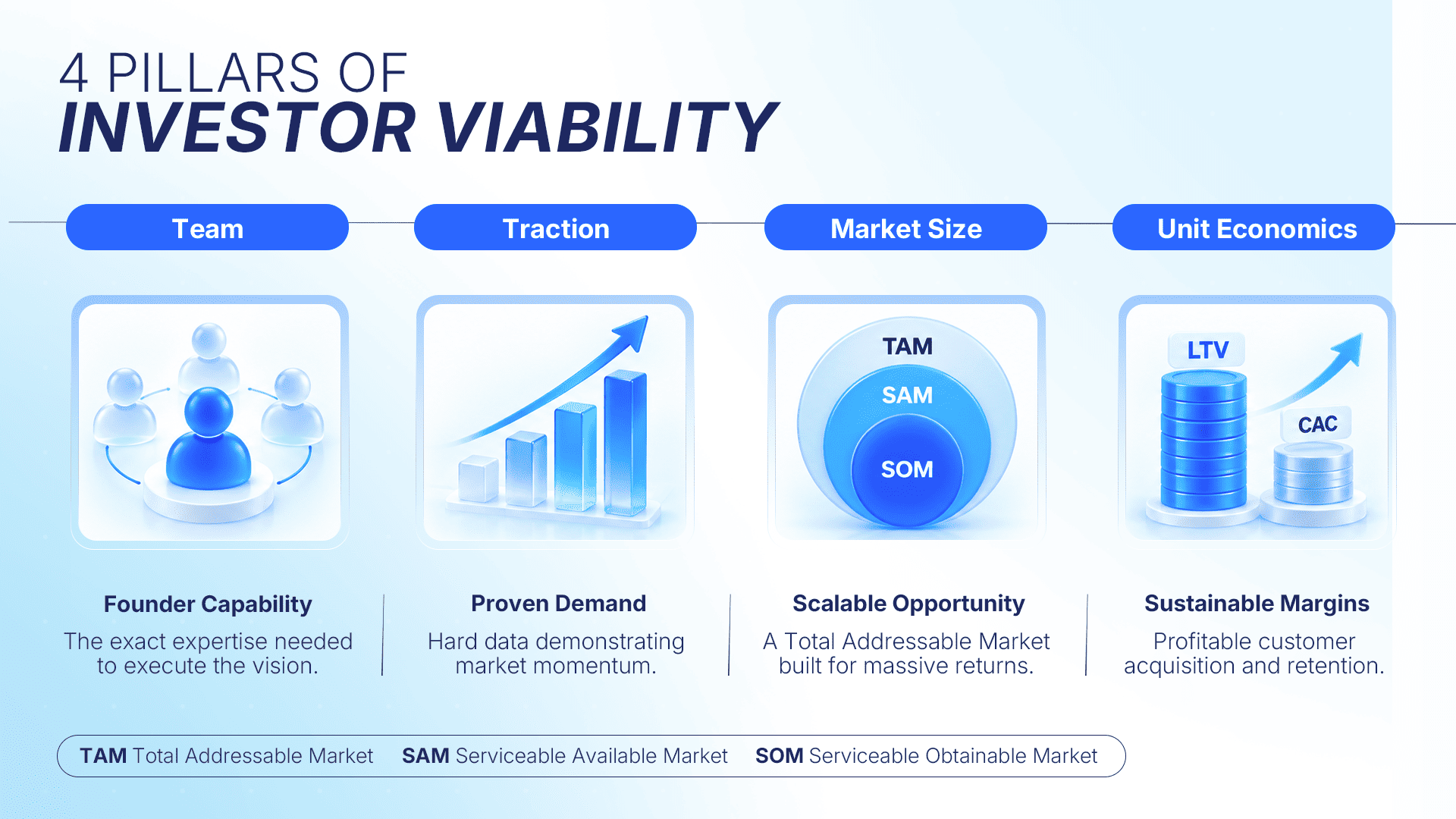
When a VC opens your deck, they scan quickly for specific viability signals. Investors generally focus on four core pillars:
- Team: Does this specific group of founders have the unique background required to execute this vision?
- Traction: Is there tangible proof that the market wants this product (such as MRR, active users, or customer waitlists)?
- Market Size: Is the problem large enough to yield a massive return on investment?
- Unit Economics: Does the math behind acquiring and retaining a customer make long-term financial sense?
How Long Should an Investor Pitch Deck Be?
The commonly cited guideline is 10–15 slides. Brevity matters in investor meetings because time is limited. If your deck requires 40 slides to explain your business, investors will often assume your strategy lacks focus.
If you are struggling to cut down your slide count, there are AI tools that build pitch decks for you, which can help trim your core narrative. However, AI is best used strictly for structural outlining; before you bring in the human touch to finalize the visual hierarchy and enterprise polish.
What Makes a Good Pitch Deck (Expert Perspective)
A great pitch deck tells a compelling story backed by visual proof, ensuring your most important messages land effectively. A mediocre pitch deck simply lists facts.
Having designed over 2 million slides for enterprise clients, our team at 24Slides knows that a winning presentation hinges on four core pillars: a clear narrative, intentional visual design, actionable data visualization, and concise copy.
When these elements align, your deck translates complex strategy into an unmissable business opportunity.
What Does a Great Pitch Deck Example Look Like?
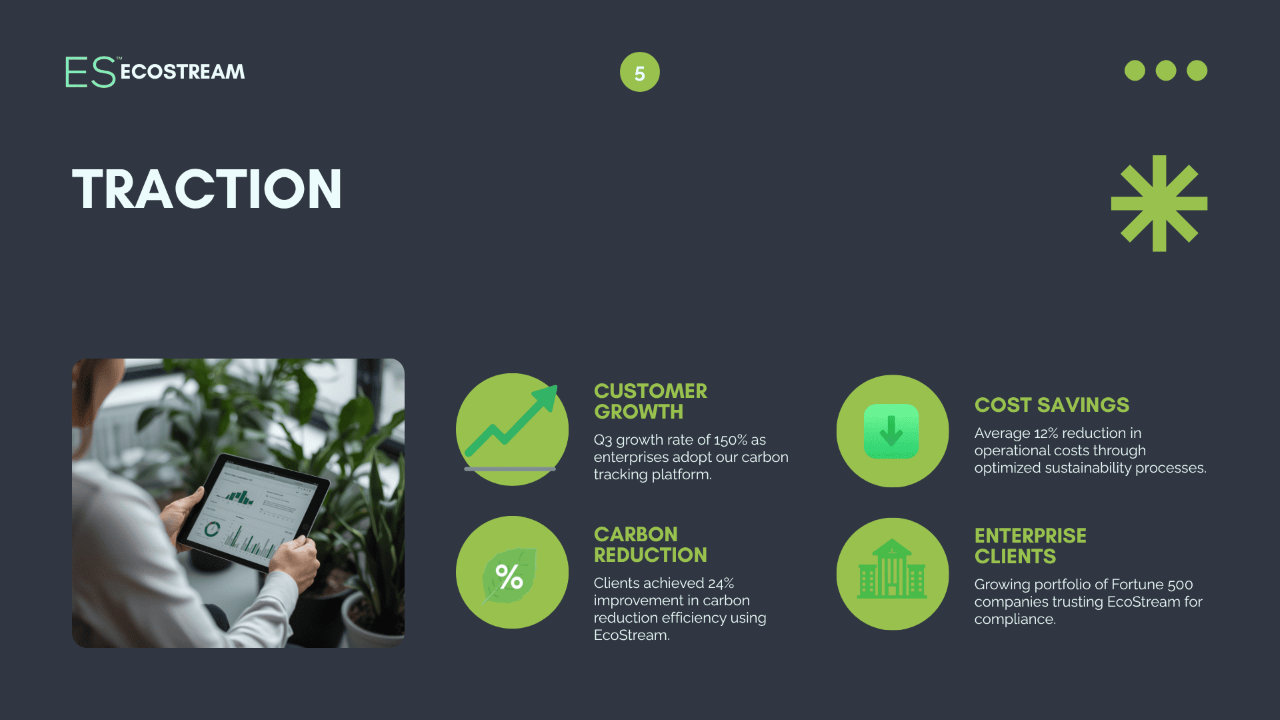
To see the difference between a quick draft and a great presentation, look at our recent EcoStream benchmark prompt test. We stress-tested dozens of AI presentation makers by asking them to generate a highly constrained 8-slide VC pitch deck for a fictional SaaS startup.
Before: The Canva Template Draft
After: The 24Slides Professional Redesign
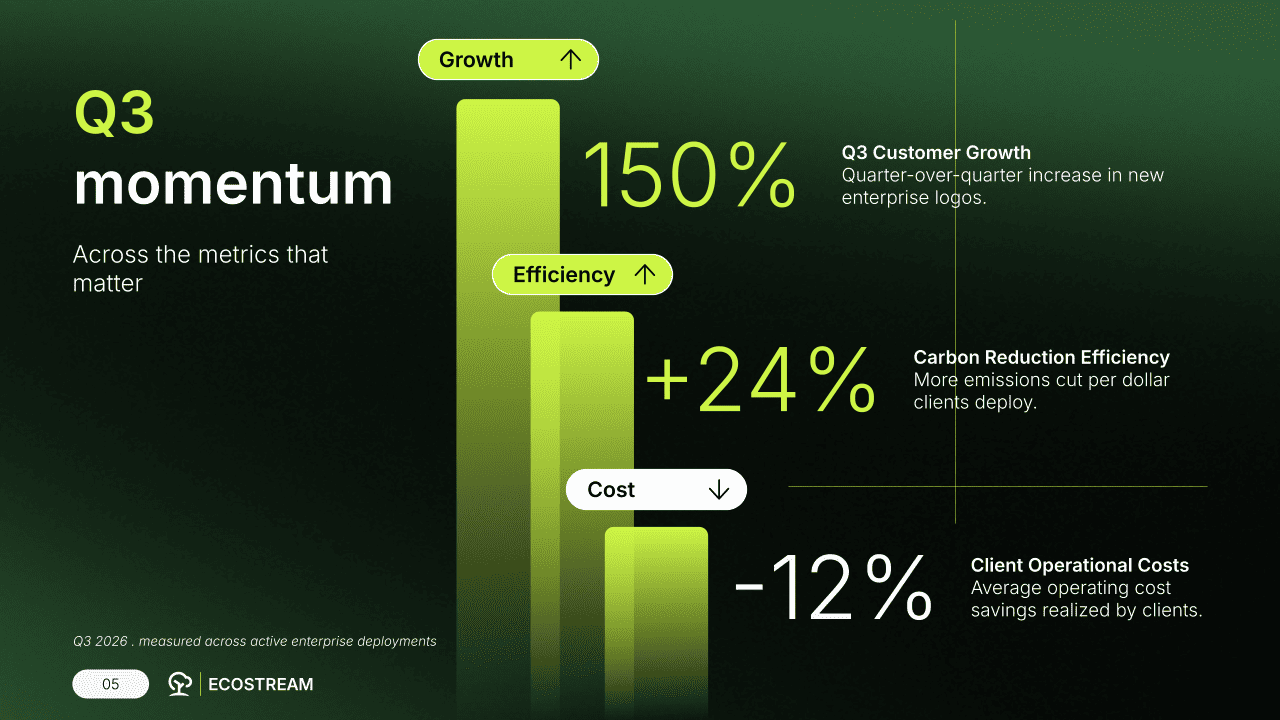
Our marketing designers, Gabriel Morales and Leonardo Acaro, transformed raw AI drafts into polished presentations using three essential principles:
- Visual Hierarchy Over Walls of Text: Investors frequently cite dense text, no clear ask, and weak storytelling as major red flags. Replacing uniform text blocks with strong focal points makes key metrics, like the 150 percent customer growth rate, instantly unmissable.
- Actionable Data Visualization: A mediocre deck simply lists facts. A strong presentation turns abstract numbers into clean custom charts, highlighting unit economics and market scale at a glance to support a clear narrative.
- Brand Authority: Upgrading default template graphics to structured layouts establishes enterprise polish and forces concise copy.
🔍 Explore the complete presentations:
Common Pitch Deck Mistakes to Avoid
Even promising companies get passed over when their slides trigger red flags for VCs and executive decision-makers. To ensure your presentation holds attention, avoid these four recurring mistakes:
- Text-Heavy Walls of Words: Forcing the audience to read dense paragraphs ensures they stop listening to your verbal pitch.
- Weak Storytelling & Unclear Ask: Failing to connect the problem directly to your solution, or leaving the audience guessing what capital or partnership commitment you need.
- Inconsistent Visual Design: Misaligned fonts, chaotic color schemes, and poor formatting signal a lack of operational discipline and enterprise polish.
- Missing Financial Metrics: Omitting clear unit economics, total addressable market (TAM) size, or high-level revenue projections.
Design Tips That Make a Pitch Deck Stand Out
To elevate your presentation from a basic draft into an enterprise-grade asset, focus on these essential design pillars:
- The "Rule of One Takeaway": Limit each slide to one core message. If you are explaining unit economics, do not crowd the same slide with your go-to-market strategy—reducing cognitive load keeps your audience focused on the pitch.
- Intentional Visual Hierarchy: Use stark contrast, visual scale, and generous white space to guide the viewer’s eye directly to your key metrics before they read a single word of body copy.
- Strict Brand Compliance: Maintain uniform typography, precise slide margins, and strict brand color palettes across every slide to build immediate, subconscious trust with investors.
- Actionable Data Visualization: Replace dense, tabular spreadsheets with clean, custom charts that showcase market growth, traction, or financial projections at a glance.
- Action-Oriented Slide Headers: Swap generic titles (such as "Market Size" or "Traction") for takeaway assertions (like "Market Size: $10B TAM Growing at 25% YoY") so busy stakeholders grasp your point instantly while skimming.
While DIY tools and AI presentation generators offer quick starting points, high-stakes boardroom presentations require human expertise. Relying on subject-matter experts or salespeople to double as slide designers creates hidden productivity costs and risks off-brand communication.
By partnering with a managed presentation design service like 24Slides, your team can focus entirely on high-value messaging while our specialists ensure your presentation is clear, credible, and on-brand.
Pitch Deck vs. Other Business Documents
Founders, agency leaders, and enterprise teams frequently struggle to decide whether they actually need a pitch deck or a completely different business document. Format mismatch is a silent deal-killer. Emailing a 40-page technical business plan to a venture capitalist who expects a 10-slide visual deck usually ends in a swift rejection.
Having evaluated thousands of high-stakes presentation briefs across enterprise industries, our team at 24Slides knows the exact nuances that separate each document type and precisely when to use each one.
Comparison Matrix: Pitch Deck vs. Business Plan, Sales Deck, and One-Pager
| DOCUMENT | PRIMARY AUDIENCE | PRIMARY GOAL | LENGTH |
|---|---|---|---|
| Pitch Deck | Investors, Enterprise Buyers, Partners | Secure a follow-up meeting, generate buy-in, or win funding | 10–20 Slides |
| Business Plan | Banks, Lenders, Internal Operations | Detail operational strategy, financial modeling, and risk management | 20–50+ Pages |
| Sales Deck | B2B Prospects & Enterprise Buyers | Drive revenue, demonstrate ROI, and close contracts | 10–15 Slides |
| One-Pager | Busy Executives, VC Partners | Provide a fast, top-level overview to spark initial curiosity | 1 Page |
Pitch Deck vs. Business Plan
Format and intent separate these two documents. A pitch deck is short, visual, and designed to build emotional momentum. A business plan is a written, exhaustive operational audit.
Pitch decks are used as the opening hook to secure an initial pitch meeting. Once an investor enters formal due diligence, you hand over the comprehensive business plan and data room to back up your claims.
Pitch Deck vs. Sales Deck
Both formats rely on visual slides, but their core incentives diverge completely. An investor pitch deck sells equity and future market upside to secure capital. A sales deck sells immediate business outcomes, ROI, and product functionality to drive recurring revenue.
In a sales deck, slides about company valuation are eliminated and replaced entirely with prospect pain points, integration timelines, and enterprise pricing models.
Pitch Deck vs. One-Pager (and Elevator Pitch)
When reaching out to busy stakeholders, you need to match your document to the medium:
- Pitch Deck vs. One-Pager: A one-pager is a single-page PDF executive summary. Sending a one-pager as a cold email attachment respects an executive's time and earns you a meeting to present the full deck.
- Elevator Pitch vs. Pitch Deck: An elevator pitch is purely spoken—a 30-to-60-second verbal summary of your business. A pitch deck provides structured visual support for a scheduled 15- to 30-minute formal presentation.
Frequently Asked Questions
What software is best for making a pitch deck?
For secure collaboration and enterprise compatibility, PowerPoint and Google Slides remain the industry standards. While AI platforms like Canva or Gamma offer quick templates, software alone does not solve presentation bottlenecks.
When weighing AI platforms vs. professional designers, high-stakes communication ultimately requires human judgment to ensure strict brand compliance across the final slides.
How much does a professionally designed pitch deck cost?
Costs vary depending on the provider and your operational needs. Freelancers might charge a few hundred dollars per project, but relying on them often compromises confidentiality, continuity, and brand consistency. Traditional agencies offer high quality but typically charge premium project-level prices with slow timelines.
Because pitch decks often come with urgent, high-pressure deadlines, enterprise teams prefer managed design partners like 24Slides. We provide reliable delivery within 24 hours, alongside priority 10-hour turnaround options, ensuring your presentation is ready for the moments that matter without the friction of unpredictable per-project fees.
What is a teaser deck?
A teaser deck is a highly condensed version of a pitch deck (typically three to five slides). It is used as a cold outreach attachment to generate initial investor interest. It highlights the core problem, the solution, and the market size, but intentionally omits highly confidential financial data or unit economics until a formal meeting is secured.
What is a pitch deck used for in film or creative projects?
In the entertainment industry, a pitch deck (often called a "treatment" or "lookbook") is used to sell a film, television show, or advertising campaign concept to studios or networks.
Unlike corporate business decks that index heavily on financial modeling and total addressable market (TAM), creative pitch decks rely primarily on mood boards, visual aesthetics, and character summaries.
Presentation Count.
Get reliable, brand-trained design capacity whenever you need it.
Never let internal bottlenecks ruin a high-stakes pitch.
Elevate your high-stakes presentations with our core pitch deck guides: