How to Link or Embed an Excel File in PowerPoint? Quick Guide!

Quick Answer: Link for Live Data, Embed for a Fixed Snapshot
To integrate Microsoft Excel data into a PowerPoint presentation, your choice depends entirely on whether your dataset requires ongoing updates or strict data preservation:
- Link Excel Data for real-time synchronization. Any modifications made to the source spreadsheet will instantly update on your PowerPoint slides. This method keeps your presentation file size minimal because the external dataset is referenced rather than stored directly inside the deck.
- Embed Excel Data when you need a permanent, self-contained snapshot. The embedded table or chart becomes an independent part of the presentation file, unaffected by changes to or relocation of the original Excel workbook. Note that sharing an embedded file grants recipients full visibility and access to all underlying Excel worksheets, including hidden tabs.
TL;DR
How do you LINK Excel Data to PowerPoint Slides? (Data is automatically updated)
If you frequently work with Excel and PowerPoint, this step-by-step guide is designed to save you time in your daily tasks significantly.
- The first step is to create the graph or chart you want in Excel. In this example, we are going to make a bar chart in Excel.
- If you want, you can customize your chart in the tabs Chart Design and Format.

- Save the Excel worksheet you want to link to PowerPoint.
- Press "Ctrl + C" to copy your Excel data.
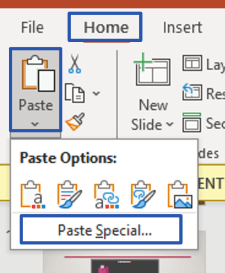
- Open PowerPoint and go to the Home tab > Paste > Paste Special.
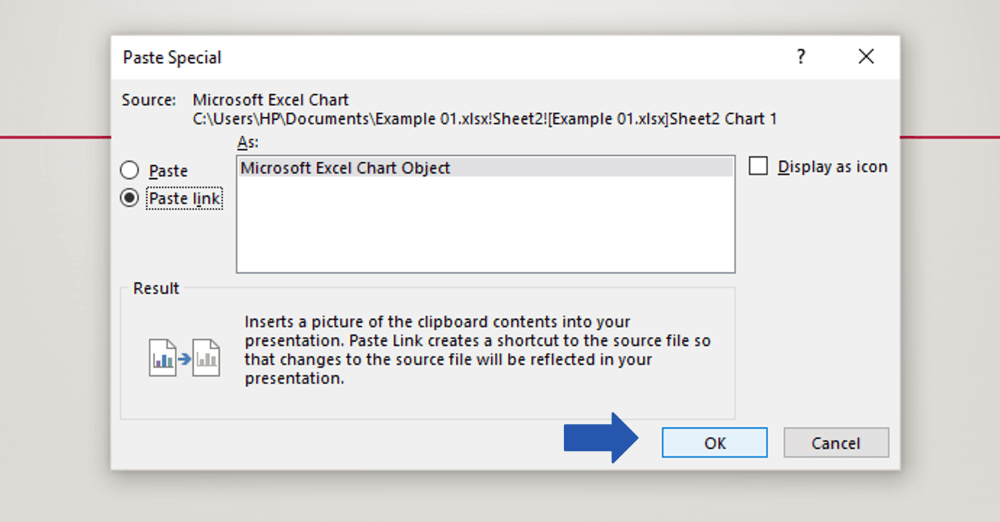
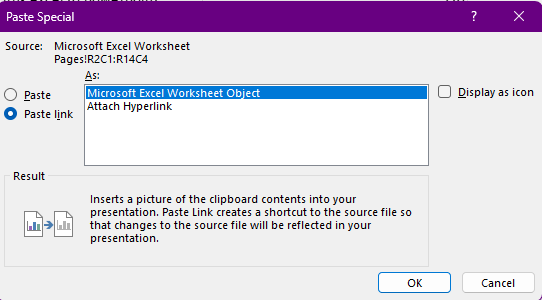
- A pop-up window will open, where you must check the option "Paste link as Microsoft Excel Chart Object."
- Press "OK," and you will now have Excel data inserted into PowerPoint.
How to Customize your Linked Data in PowerPoint?
If you want to explore more design options in PowerPoint, when pasting your graphic, you need to choose another type of paste:
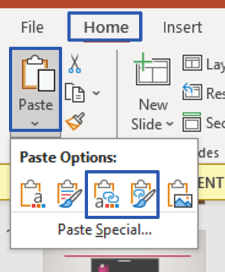
- Go to the Home tab in PowerPoint > Paste > Paste Options.
- Click "Use Destination Theme and Link Data" or "Keep Source Formatting and Link Data." You can also use the shortcuts, the "L" and "F" keys, respectively.
- At first, the charts will have a transparent background, but you can edit the colors and layouts in the Chart Design tab.
Check the final result of our Excel file linked in PowerPoint:
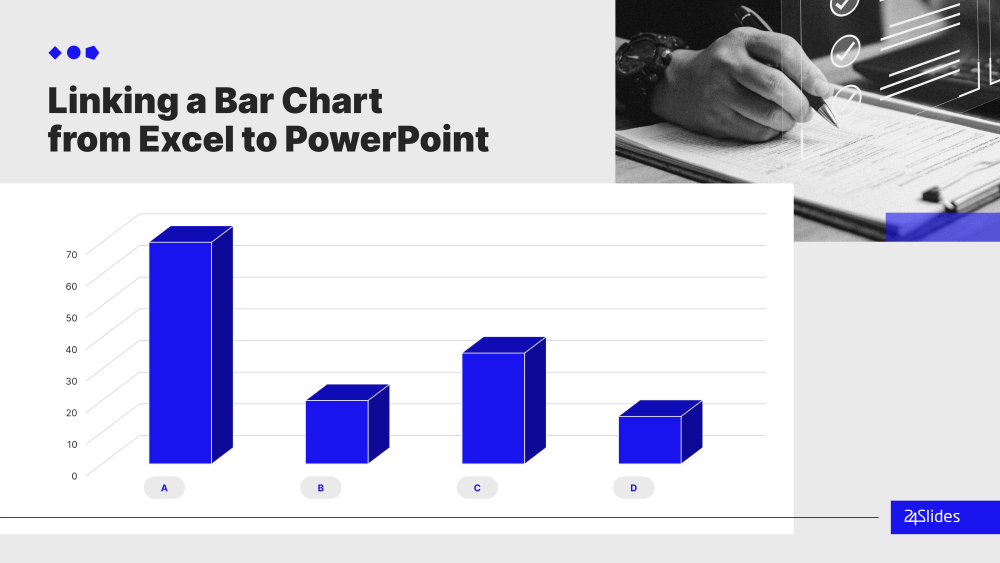
Now, you know how to insert data from Excel to PowerPoint!
Let's check the second way to do it.
How do you EMBED Excel Data to PowerPoint Slides? (Data is not automatically updated)
To learn how to embed an Excel file into PowerPoint, we will use a data table as an example:
- First, build your table in Excel.
- Save the file on your computer.
- Select your table and press "Ctrl + C."
- Go to your PowerPoint file.
- Right-click on the slide to see different "Paste Options" (this is another way to paste information from Excel to PowerPoint).
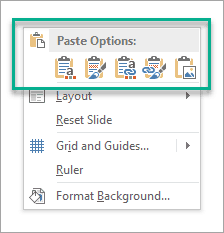
- Choose the middle option: "Embed," and that's it!
- As this is a data table, you can freely edit the information in PowerPoint.
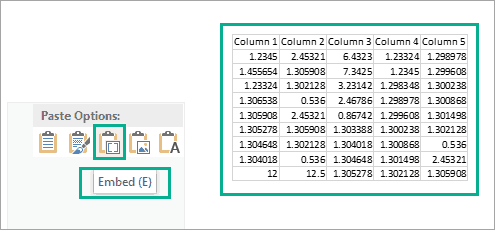
- Reminder: If you embed an Excel file into PowerPoint, the information you modify in Excel will not be reflected in PowerPoint.
How to Customize your Embedded Data in PowerPoint?
In case you want to use PowerPoint features to customize your chart, keep the following steps in mind when pasting your Excel chart:
- Right-click on the slide you want to paste your content.
- Choose either of the first two options: "Use Destination Styles" or "Keep Source Formatting." Also, you can use the shortcuts, the "S" and "K" keys, respectively.
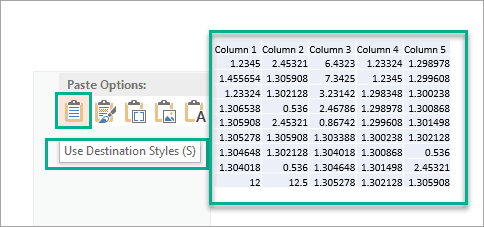
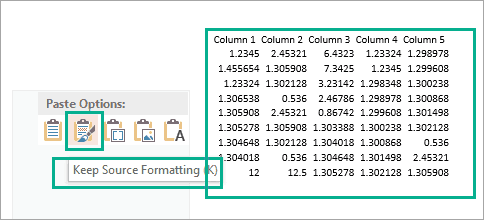
- When you click on your chart, these tabs will be enabled: Table Design and Layout. There, you can edit the colors, line sizes, cell sizes, and more!
Here is the final result of our Excel file embedded in PowerPoint:
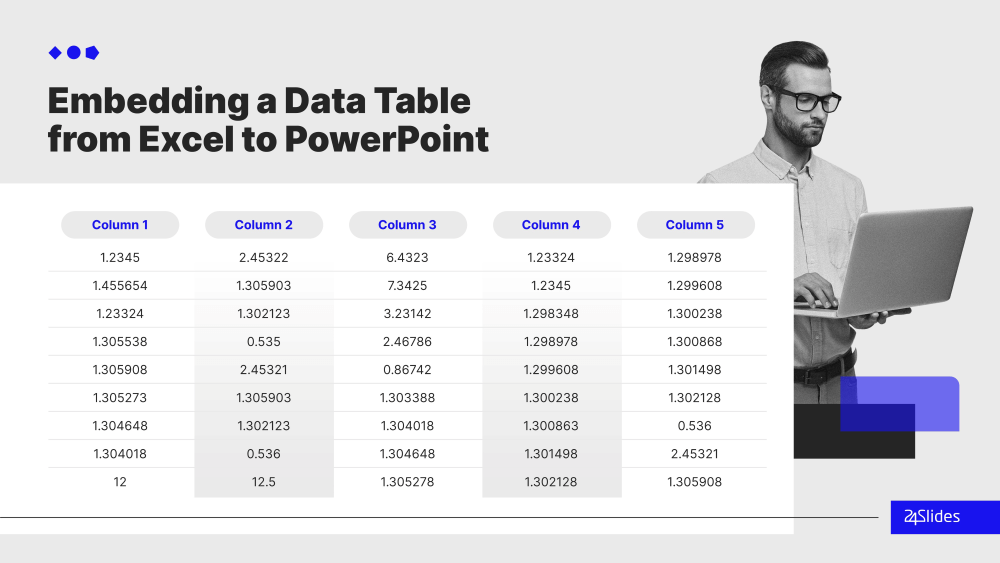
That's it! By following each step carefully, you will master how to insert an Excel sheet into PowerPoint.
But which option is the best for you? Let's figure it out!

Linking vs. Embedding: Side-by-Side Comparison
When determining whether to link Excel to PowerPoint or execute an independent file injection, evaluating cross-functional performance trade-offs is critical. Embedding Excel in PowerPoint versus maintaining an active data pipeline fundamentally dictates your presentation's security, file portability, and future reporting workflow.
The table below provides a side-by-side technical breakdown to help you map the right integration protocol to your specific deck delivery requirements:
Mastering how to insert Excel into PowerPoint through these built-in functionalities ensures your data narrative stays reliable and highly structured.
- When to link: If your metrics are evolving up until the moment you present, choosing to link Excel to PowerPoint ensures your slides remain perfectly synchronized with your backend spreadsheets without tedious manual updates.
- When to embed: If your current presentation objective demands an external send-off that remains uncorrupted by path shifts, learning how to embed an Excel file in PowerPoint is your best option.
| Approach | Pros (Advantages) | Cons (Disadvantages) |
|---|---|---|
| Linking |
• Auto-Sync: Changes made in Excel update instantly in PowerPoint.
• Low File Size: PowerPoint stays small because data is not stored internally.
• Full Features: Retains complete access to all PowerPoint tools.
|
• Broken Paths: Links fail if the source Excel file is renamed or moved.
• No File Access: Shared recipients see the data, but cannot open the original Excel file.
|
| Embedding |
• All-in-One File: Shared recipients can view the data and open the full Excel spreadsheet.
• Full Features: Retains complete access to all PowerPoint tools.
|
• No Auto-Sync: Edits to the original Excel file will not update in PowerPoint.
• Bloated File Size: Storing whole spreadsheets can heavily increase the presentation's size.
• Data Exposure: Anyone with the deck can access all worksheets, including hidden ones.
|
What Breaks a Linked Excel File (and How to Prevent It)
While learning how to link Excel to PowerPoint can transform your reporting workflow, relying on standard corporate templates without understanding path mechanics often results in broken slides.
- File Path Disruptions: PowerPoint locates your data using explicit file paths. Renaming your .xlsx source document or moving it to another directory instantly breaks this text reference, producing an unrefreshable data frame.
- Cloud Drive Sync Mismatches: Saving spreadsheets to directories managed by OneDrive or SharePoint can cause path changes during background sync processes, orphaning your presentation's active data references.
Proactive Strategies to Protect Your Data
To avoid formatting errors and broken links during a live presentation, implement these operational safeguards:
- Keep your presentation and source workbook saved within the exact same folder structure before creating links.
- Use a stable, shared network location or corporate cloud folder with fixed access paths to prevent background permission issues.
When Linking or Embedding Is the Wrong Choice
While mastering how to insert Excel into PowerPoint streamlines many reporting tasks, native integration features are not always the ideal solution for every operational workflow. Avoid both methods if your presentation requirements match these specific scenarios:
- External Email Distribution: If you plan to email a deck externally without attaching the original workbook, according to PowerUser, choosing to link Excel to PowerPoint triggers immediate path failures. For simple, one-off external deliveries, pasting your dataset as a static, flat image or unlinked table remains much more dependable.
- High-Frequency Data Streams: If your underlying metrics update multiple times per day, neither standard linking nor trying to embed Excel in PowerPoint will scale efficiently. Dynamic, rapid data shifts require a dedicated, live-connected BI dashboard or automated reporting tool to remain durable.
- Strict Brand Formatting Control: Live-linked or embedded arrays carry default gridlines and spreadsheet margins that frequently break presentation layouts. When uniform branding across customer-facing decks takes precedence over raw automation, a professionally rebuilt slide delivers a far superior aesthetic.
Recognizing these boundaries helps prevent corrupted files and unprofessional layouts before your meeting begins. Evaluate your distribution audience and formatting priorities beforehand to ensure your chosen data integration remains stable.
Frequently Asked Questions
How do I insert an Excel sheet in slides?
To insert Excel into PowerPoint layouts cleanly, you have two primary options based on your workflow needs:
- The Copy-Paste Method: Open your spreadsheet, highlight the cell range, and press Ctrl + C. Open PowerPoint, select your slide, and right-click to choose Embed from the available Paste Options. This generates an editable Excel object directly on the slide surface.
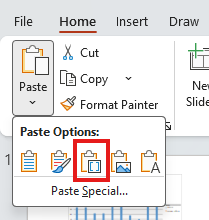
- The Special Paste Protocol: Use the Paste drop-down menu on your Home tab, access the Special menu, and establish either an independent or live link object.
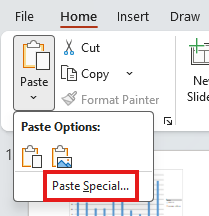
Can you auto-populate a PowerPoint from Excel?
Yes, you can easily link Excel to PowerPoint assets to automate recurring executive data reports:
- Highlight the target metrics array inside your spreadsheet and copy it using Ctrl + C.
- Inside PowerPoint, click the drop-down arrow under the Paste button on the Home tab and open Paste Special.
Does a linked Excel file update automatically when I open the PowerPoint file?
Yes, it does. When you choose to link Excel to PowerPoint tables or graphics, PowerPoint reviews your paths upon file execution:
- If both documents remain in their saved file directories, a secure pop-up box will appear asking to verify external references.
- Click Update Links, and PowerPoint will scan the absolute system paths to pull fresh cell entries instantly.
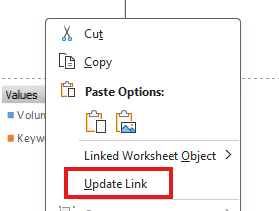
- If your deck is already open, right-click the linked range window and click Update Link to manually pull numbers on command.
How do I paste an Excel table into PowerPoint without losing formatting?
To maintain your original font sizing, background fills, and grid boundaries across programs, use specific paste properties:
- Highlight and copy your styled data array within Excel.
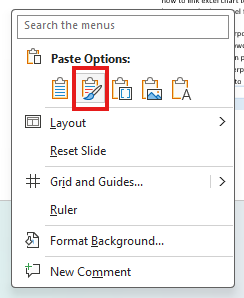
- Navigate to your slide canvas, right-click to reveal the contextual menu, and look at the first two clipboard configurations.
- Choose Keep Source Formatting (or use the K key shortcut) to import rows as a native presentation table that keeps your precise spreadsheet design intact.
Get a Polished, Data-Accurate Deck Without the Manual Fixes
Deciding whether to link Excel to PowerPoint templates for live data synchronization or embed Excel in PowerPoint presentations for self-contained portability depends entirely on your specific organizational goals. However, mastering how to insert Excel into PowerPoint grids cleanly shouldn't mean sacrificing valuable hours fixing broken layouts, distorted charts, or misaligned margins.
Instead of letting manual presentation formatting bottlenecks disrupt your reporting cycles, let 24Slides handle the heavy lifting. Backed by over 14 years of dedicated presentation design experience, our global team of 200+ professional designers specializes in transforming raw, complex datasets into polished, executive-ready slide decks.
- Tailored Timelines: Secure your completed presentations exactly when your team needs them with guaranteed 24, 48, or 72-hour turnaround options.
- Proven Corporate Impact: Join thousands of satisfied clients globally who trust our corporate design infrastructure to deliver pixel-perfect, brand-compliant slides every single day.
Stop wrestling with spreadsheet paste options and focus entirely on your core insights.

You might also find this content interesting: