How to Hyperlink in PowerPoint

Select your text, shape, or image and press Ctrl+K (Windows) or Cmd+K (Mac) to open the Link dialog box. Choose your destination, an external website, a specific slide, a file, or an email address, and click OK. To avoid breaking template styles, always update link colors via the Design tab's master palette rather than manually recoloring text. When manual link maintenance across massive decks becomes a liability, let 24Slides build your interactive navigation frameworks.
TL;DR
- Quick Answer: Insert a Hyperlink in 4 Steps: Master the universal Ctrl+K (Cmd+K on Mac) shortcut to make text, shapes, or images clickable in seconds without hunting through Microsoft 365's renamed ribbon.
- Hyperlink to a Website in PowerPoint: How to mask sprawling URLs behind clean anchor text via the Link dialog—or trigger PowerPoint’s built-in auto-convert engine with a single Spacebar tap.
- Hyperlink to Another Slide in the Same or a Different Presentation: Build interactive agendas and appendix jumps, plus the critical gotcha: reordered slides update automatically, but deleted target slides break silently.
- Hyperlink to an Email Address in PowerPoint: Replace static contact info with one-click email triggers that automatically pre-fill custom subject lines to streamline inbound prospect routing.
- How to Add a ScreenTip in PowerPoint: Use PowerPoint’s best-hidden micro-feature to display sleek, custom hover notes over icons and buttons instead of raw, hundred-character file paths.
- How to Change the Color of a Hyperlink: Why manually repainting text breaks template consistency during corporate updates, and how to adjust link palettes properly at the master theme level.
- How to Make Any Object Clickable in PowerPoint (Shapes, Images, Icons): The exact border-selection technique required to turn graphic containers, screenshots, and vector icons into clickable buttons without ugly blue underlines.
- How to Edit or Remove a Hyperlink in PowerPoint: Update outdated URLs or strip click interactivity via right-click controls without accidentally wiping the underlying text or graphics off your canvas.
- Hyperlink Destination Types in PowerPoint (Comparison Table): A side-by-side reference matrix mapping all 5 dialog targets (Web, Same Deck, External File, New File, Email) to their ideal presentation use cases.
- When Manual Hyperlinking Isn't the Right Approach: Why DIY linking breaks down across 50+ slide decks, and when ongoing link maintenance shifts from a quick hack into an operational bottleneck.
- FAQ: Common Questions About Hyperlinks in PowerPoint: Direct answers covering universal shortcuts, clickable shape buttons, and how to stop broken file paths when sharing decks.
- Get Your Decks Fully Linked and On-Brand: How 24Slides' dedicated, brand-trained designers engineer seamless navigation structures and brand governance with reliable 24-hour turnaround.
Nothing kills presentation momentum faster than dropping out of slideshow mode just to copy and paste an awkward 80-character URL into a browser. Whether you are building an interactive table of contents, directing clients to a financial model, or linking an icon to your company portal, mastering how to hyperlink in PowerPoint turns clunky navigation into a seamless, executive-ready experience.
One Design Partner
From infographics and reports to full marketing collateral, built on demand.
Quick Answer: Insert a Hyperlink in 4 Steps
Fast Track: Ctrl+K (Windows) or Cmd+K (Mac) works on selected text, shapes, or images, faster than navigating the ribbon for teams who build decks repeatedly.
If you need a reliable method for inserting a link in PowerPoint right now, follow these four steps:
- Select the Object: Highlight the specific text, click the border of a shape, or select the image you want to make interactive.
- Open the Link Dialog: Press Ctrl+K (Windows) or Cmd+K (Mac). Alternatively, head to the top ribbon and click Insert > Link. (Note: Modern Microsoft 365 labels this button "Link," whereas legacy versions call it "Hyperlink.")
- Choose Destination: In the dialog window's left pane, pick where the link goes: an Existing File or Web Page, a Place in This Document, a Create New Document action, or an E-mail Address.
- Confirm: Paste your destination URL or pick your target slide number, then click OK.
Hyperlink to a Website in PowerPoint
Sending your audience to an external case study, live SaaS dashboard, or client portal is standard practice. Knowing how to add a hyperlink in PowerPoint allows you to route viewers straight to your web source without disrupting the visual rhythm of your presentation.
Using the Insert Link Dialog Box
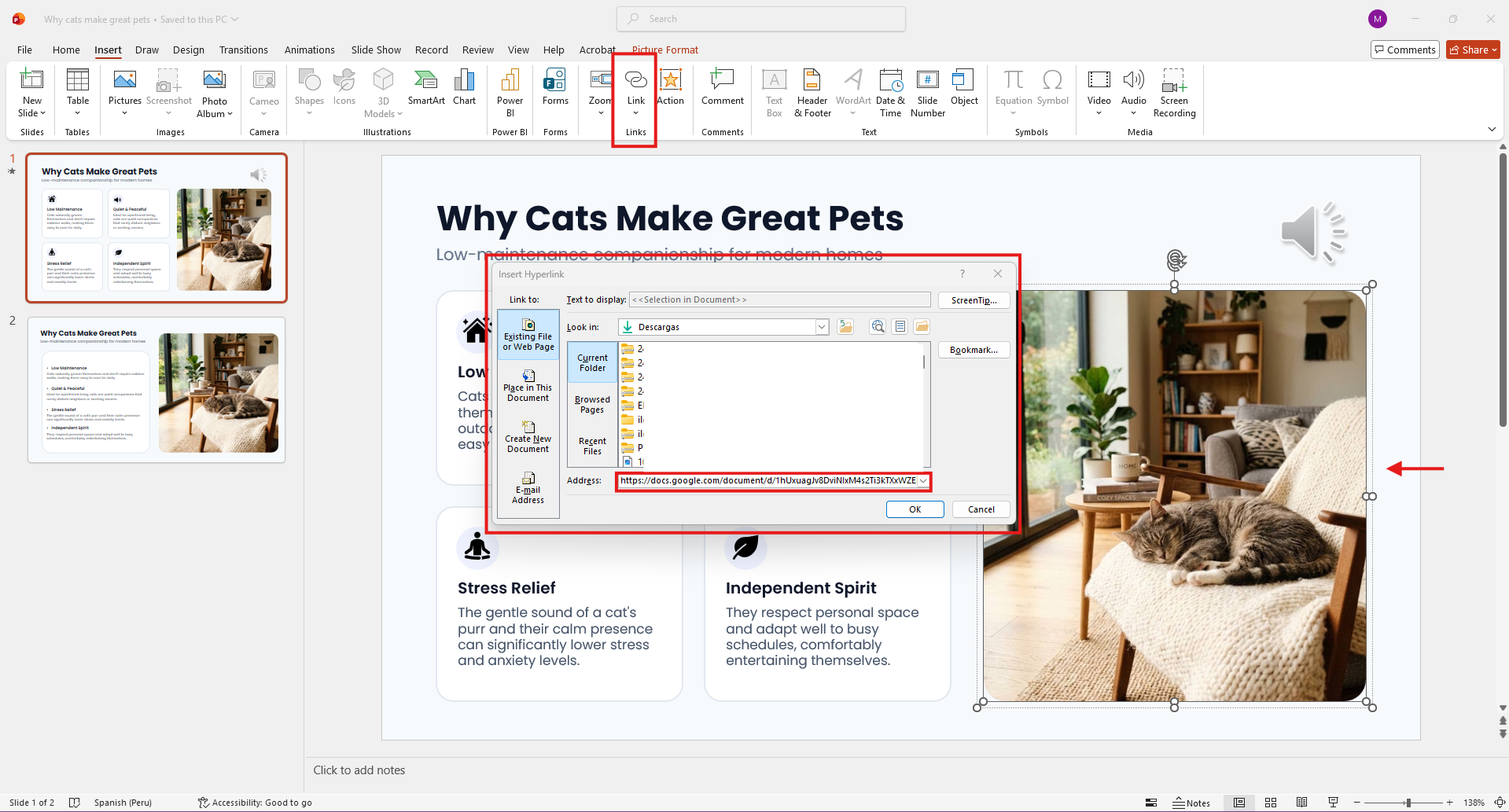
The standard dialog window gives you complete control over your anchor text, ensuring you never have to clutter a slide with ugly, sprawling URLs. Here is how to insert a hyperlink into PowerPoint text, shapes, or images:
- Highlight the Target Element: Click and drag to select your specific anchor text, or click the outer border of a vector icon, shape, or screenshot.
- Open the Link Tool: Go to the Insert tab on the ribbon and click Link (or press your shortcut: Ctrl+K on Windows or Cmd+K on Mac).
- Select the Web Panel: In the left-hand sidebar of the dialog window, click Existing File or Web Page.
Paste Your Destination: Click inside the Address: field at the bottom, paste your full destination URL (make sure it includes https://), and hit OK.
Auto-Convert a Pasted URL (No Dialog Box Needed)
Need the fastest possible way to get a live URL onto a slide without clicking through menus? PowerPoint features a built-in auto-detection engine that turns typed URLs into active links on the fly.
When you type or paste a complete URL (beginning with http://, https://, or www.) directly into any text box, PowerPoint initially treats it as plain text. The secret trigger? Press the Spacebar or tap Enter. The instant you register that keystroke, PowerPoint evaluates the text string and automatically converts it into a live, clickable link.
While auto-linking is handy for quick internal reference notes, it leaves raw URL strings exposed. For board-level decks, stick with the dialog box to keep links neatly masked behind punchy, descriptive labels.
Hyperlink to Another Slide in the Same or a Different Presentation
Jumping linearly from slide 1 to slide 50 is fine for a campfire story, but executive presentations rarely move in a straight line. Learning how to place a hyperlink in PowerPoint that connects different slides turns a rigid deck into a sleek, non-linear navigation system where you can jump to backup slides on command.
Link to a Slide in the Same Deck
Building an interactive table of contents or an executive summary menu takes just a few clicks. If you've ever wondered how to put a hyperlink in a PowerPoint to jump straight to an appendix data slide, follow these steps:
- Select Your Trigger: Highlight the text label, or click the perimeter of a button shape or icon.
- Launch the Link Menu: Press Ctrl+K (Windows) or Cmd+K (Mac), or go to Insert > Link.
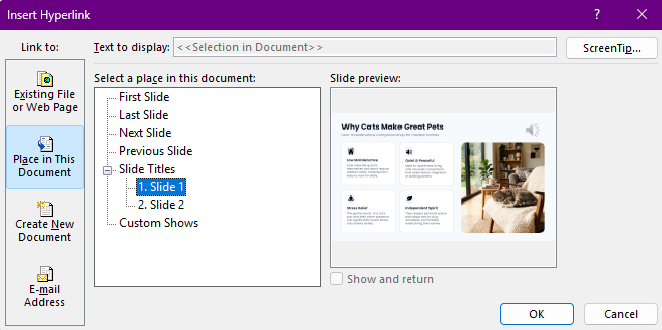
- Choose Local Document: In the left-hand pane, click Place in This Document.
- Target the Slide: PowerPoint will display your entire slide outline. Select your destination slide by its title or number (a live preview thumbnail will appear on the right to verify your choice).
- Confirm: Click OK to lock in the jump.
Link to a Slide in a Different Presentation File
If your pitch references an external master deck or a deep-dive financial model, you can link across separate files:
- Open the Link dialog box (Ctrl+K / Cmd+K) on your selected anchor element.
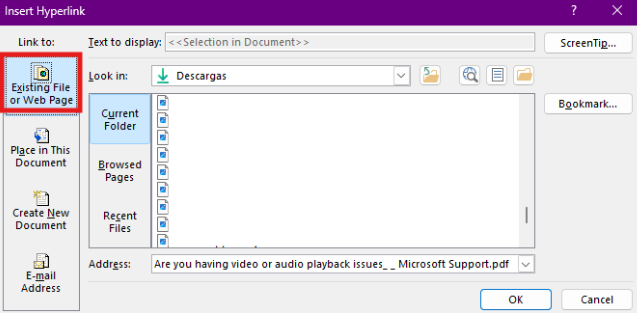
- In the left navigation list, select Existing File or Web Page.
- Use the file browser to locate and select the target .pptx file.
- Click the Bookmark… button on the right side of the window. PowerPoint will open a sub-menu listing every slide inside that secondary file.
- Pick the target slide, click OK, and click OK again. (Pro tip: Always store both presentation files in the same shared folder or cloud directory, or the link will break the moment you email the deck.)
The Gotcha: What Happens When You Delete or Reorder the Target Slide
Slide decks are constantly evolving, making slide links vulnerable to accidental breakage.
Here is the golden rule: If you reorder slides after linking, PowerPoint automatically updates the reference. If you delete the target slide, the hyperlink breaks silently; no warning dialog appears when you click Present or export to PDF.
Instead of showing an error message, clicking a broken link during a presentation simply does nothing, leaving you stranded on the current slide. Always run a quick 30-second "click audit" in Slide Show mode before stepping up to present.
Hyperlink to an Email Address in PowerPoint
Setting up a direct email hyperlink in PowerPoint is the ultimate shortcut for closing pitch decks, sales materials, and conference presentations. Instead of forcing your audience to manually copy down text from a static "Contact Us" slide, an interactive mail link triggers their default email client with a ready-to-send draft in a single click.
Here is how to wire it up:
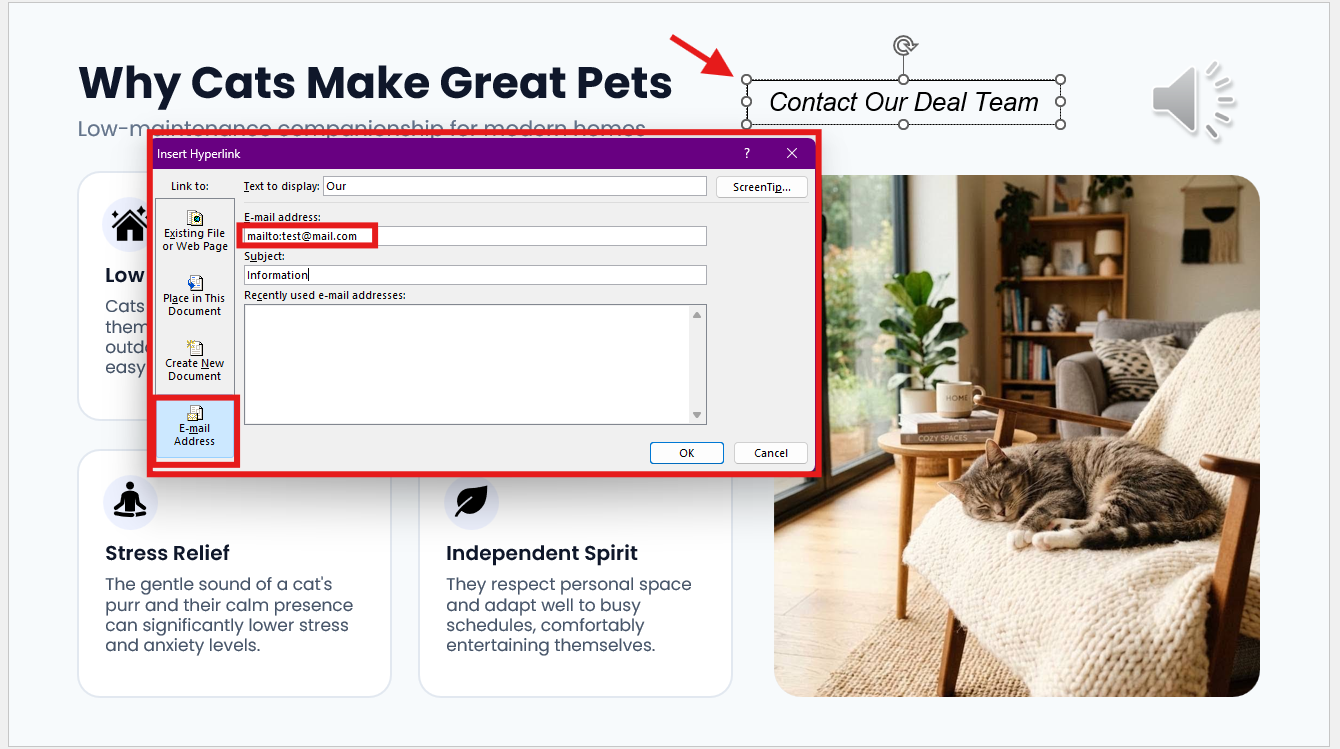
- Select the Anchor: Highlight your call-to-action text (e.g., "Contact Our Deal Team"), or click the outer boundary of a mail icon or CTA button shape.
- Open the Dialog: Press Ctrl+K (Windows) or Cmd+K (Mac), or head to Insert > Link on the ribbon.
- Select the Email Panel: In the left-hand navigation pane, click E-mail Address.
- Enter Destination: Type the target inbox into the E-mail address: box.
- Add a Pre-Filled Subject Line: Type a specific topic into the Subject: field (such as "Q4 Partnership Inquiry"). When clicked, PowerPoint automatically populates this subject line for the sender, ensuring incoming inquiries are pre-sorted and never get lost in your inbox.
- Confirm: Click OK to lock it in.
How to Add a ScreenTip in PowerPoint
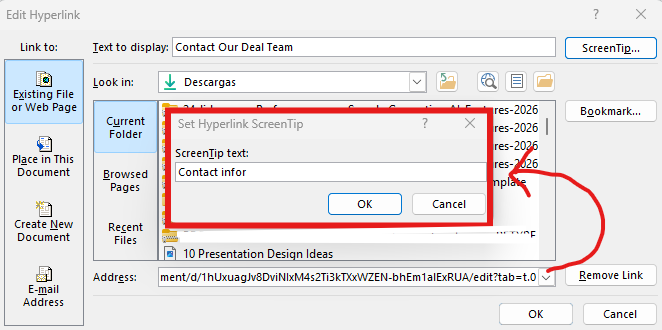
Nothing breaks visual immersion quite like hovering over a sleek interactive icon only to see a raw, hundred-character file path float onto the screen. ScreenTips are the subtle polish that elevates interactive slides from clunky manual documents to polished digital experiences.
When discovering how to hyperlink in PowerPoint, the ScreenTip… button is PowerPoint’s best-hidden micro-feature. Located in the upper-right corner of the Insert Link dialog box (Ctrl+K or Cmd+K), the button opens a prompt where you can enter custom hover text.
During Slide Show mode, hovering the cursor over your hyperlinked text, icon, or shape displays this custom note instead of the destination URL.
ScreenTips are invaluable for interactive training decks, self-guided kiosk presentations, or complex navigation dashboards. Use them to provide helpful micro-instructions (e.g., "Click to view Q3 audited balance sheet") or to define cryptic business acronyms on demand, keeping your primary slide layout clean and breathable.
How to Change the Color of a Hyperlink
Once you master how to hyperlink in PowerPoint, you’ll immediately run into a classic aesthetic hurdle: PowerPoint’s default electric-blue text and underline.
The quick fix is straightforward: highlight the hyperlinked text, jump to the Home tab on the ribbon, and choose a new shade from the Font Color dropdown. But beware, this manual override comes with a hidden cost.
Manually hardcoding font colors breaks your presentation's dynamic style inheritance. In fact, this is one of the most common brand-consistency failures the team at 24Slides encounters when auditing client decks. When presenters manually repaint individual links rather than configuring their master palette, those rogue elements fail to adapt during template refreshes or global rebrands, leaving behind mismatched, off-palette stragglers.
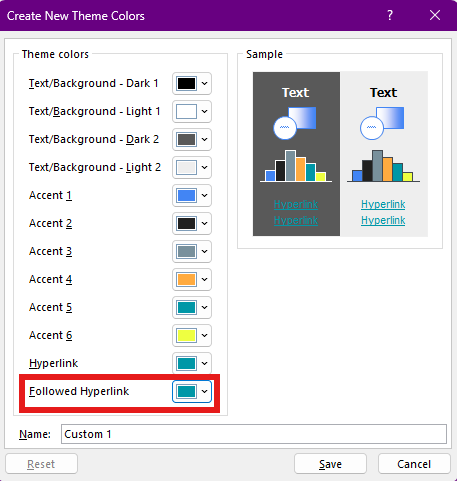
To change link colors without breaking brand governance, adjust them at the theme level. Head to the Design tab, click the Variants dropdown arrow, select Colors > Customize Colors…, and adjust the Hyperlink and Followed Hyperlink swatches directly. Every link across your deck will update instantly while preserving pristine brand consistency.
How to Make Any Object Clickable in PowerPoint (Shapes, Images, Icons)
Hyperlinks aren't restricted to standard text strings. When exploring how to hyperlink in PPT, you can transform any visual asset, custom CTA buttons, company logos, product screenshots, or vector icons, into an invisible, seamless navigation trigger without a single distracting blue underline.
The setup is virtually identical to linking text, with one critical distinction: selection precision.
Instead of highlighting words inside a shape or text box, click directly on the solid outer perimeter border of the shape, vector icon, or image bounding box. (You’ll know the object itself is targeted when its bounding frame turns solid rather than dotted, with no blinking text cursor inside).
Once selected, the exact same workflow applies:
- Press Ctrl+K (Windows) or Cmd+K (Mac).
- Choose your destination panel (an external web address, a specific slide, or an email).
- Click OK.
Wiring up interactive container cards or UI mockups is the easiest way to give your slides a responsive, app-like feel.
How to Edit or Remove a Hyperlink in PowerPoint
When colleagues ask how do you hyperlink in PowerPoint, they rarely consider what happens when a web page moves or an appendix gets restructured. Presentations evolve constantly, making ongoing link maintenance an essential skill.
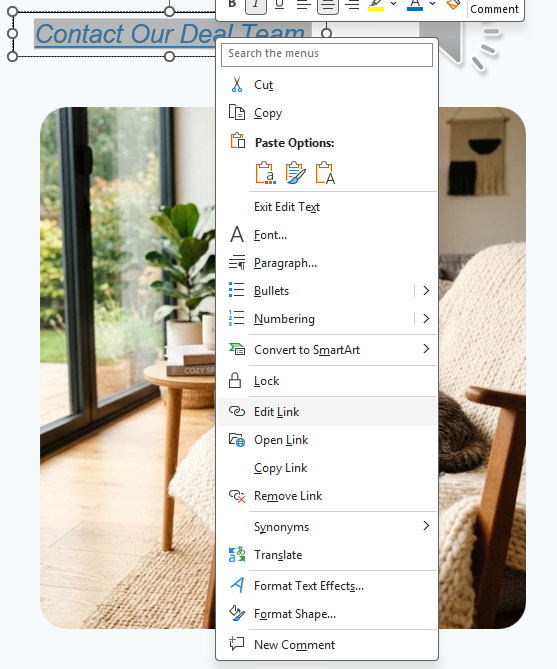
To update or strip an active link, right-click directly on the hyperlinked text, shape, or graphic:
- Edit Link: Launches the link dialog box so you can swap out an outdated URL, re-target a new slide number, or revise custom ScreenTips. (You can also select the element and press Ctrl+K or Cmd+K).
- Remove Link: Instantly unlinks the underlying web address or slide trigger.
The crucial distinction here is between clearing interactivity and destroying content. Choosing Remove Link eliminates the clickable connection and reverts text to standard body styling while leaving your wording, icons, and layout perfectly intact on the canvas. In contrast, hitting Delete or Backspace will wipe the actual asset off your slide entirely.
Hyperlink Destination Types in PowerPoint (Comparison Table)
| DESTINATION TYPE | DIALOG BOX PANEL | BEST USE CASE | KEYBOARD SHORTCUT |
|---|---|---|---|
| Web Page | Existing File or Web Page | Linking directly to live SaaS tools, online case studies, or external research sources. | Ctrl+K (Win) / Cmd+K (Mac) |
| Same Presentation | Place in This Document | Interactive table of contents, executive summary dashboards, and appendix jumps. | Ctrl+K (Win) / Cmd+K (Mac) |
| Different File | Existing File or Web Page (Bookmark) | Cross-referencing standalone financial models, master slide libraries, or external PDFs. | Ctrl+K (Win) / Cmd+K (Mac) |
| New Blank File | Create New Document | Interactive workshops and training decks where participants spawn fresh exercise notes. | Ctrl+K (Win) / Cmd+K (Mac) |
| Email Address | E-mail Address | Closing slides and "Contact Us" cards with pre-filled subject lines for lead routing. | Ctrl+K (Win) / Cmd+K (Mac) |
When planning how to hyperlink in PowerPoint, picking the right destination architecture is critical to avoid awkward glitches mid-pitch. PowerPoint offers five distinct destination targets inside the Link dialog box, each tailored to specific audience scenarios, ranging from quick slide jumps to automated communication triggers.
Selecting the proper panel up front guarantees your links behave predictably, whether your deck is being presented live on stage or distributed as a self-guided leave-behind.
When Manual Hyperlinking Isn't the Right Approach
Mastering presentation links is a lifesaver when you just need to drop a quick source link into an impromptu deck. But there is a very real line where DIY hyperlinking stops feeling like a clever productivity hack and starts feeling like an unpaid data-entry internship.
Manually hyperlinking slide-by-slide works fine for a breezy 10-to-15-slide deck. It completely stops working the moment you run into heavy volume:
- Navigating 50+ slide monsters: Where moving a single appendix slide sends half your navigation jumps into presentation purgatory.
- Rebuilding recurring monthly decks: Spending your Friday afternoon re-wiring the exact same jump menus twelve times a year.
- Standardizing multi-team templates: Trying to enforce a clickable table of contents across four different departments without someone turning a link neon purple.
At that scale, links get missed, broken, or inconsistently styled, and no amount of hyper-caffeinated, late-night clicking fixes that at volume.
This is precisely the kind of repetitive, detail-heavy formatting work a dedicated, brand-trained design team is built to absorb. Instead of burning strategic hours hunting down ghost links and auditing jump targets before a board meeting, enterprise teams hand off the grunt work so interactive navigation frameworks get hardcoded cleanly into master layouts from day one.
FAQ: Common Questions About Hyperlinks in PowerPoint
How do I add a clickable link in slides?
Highlight the text or click the outer border of the visual element you want to make interactive, then press Ctrl+K (Windows) or Cmd+K (Mac). Choose your destination category in the left pane, such as Existing File or Web Page or Place in This Document, paste the target destination address or select a slide number, and click OK. In Slide Show mode, clicking it will trigger the destination.
How to create a hyperlink?
To build an interactive link from scratch, select any piece of copy, vector icon, or illustration, then navigate to Insert > Link on the ribbon. If you're wondering how do i create a hyperlink in PowerPoint for an external website, choose Existing File or Web Page, paste your destination URL into the Address field, and click OK to activate the link.
What is the shortcut key for hyperlink in PowerPoint?
The universal shortcut to insert or edit a link in PowerPoint is Ctrl+K on Windows and Cmd+K on macOS. This keyboard shortcut functions identically whether you have selected standard text, a geometric shape, a smart card container, or a high-resolution image, instantly launching the Link dialog window without requiring ribbon navigation.
How to make clickable buttons in PowerPoint?
Insert a shape via Insert > Shapes (like a rounded rectangle), format its fill color and label, then click the shape's outer boundary. Press Ctrl+K (or Cmd+K on Mac) to open the Link window, select Place in This Document or Existing File or Web Page, specify your target slide or URL, and click OK. The entire shape container now functions as a responsive button.
Why did my hyperlink stop working after I moved the file?
PowerPoint stores relative and absolute file paths to local documents. If you move, rename, or delete the target presentation or a linked external document, or email your deck to an external client without attaching the linked asset, the underlying file path is severed. To avoid broken links, bundle all related presentation decks and linked files within the exact same shared folder or cloud directory.
Get Your Decks Fully Linked and On-Brand
Dropping a single link into a slide takes seconds. Maintaining a fully interactive navigation system across a 60-slide board deck or recurring monthly report? That is where the wheels usually come off. Between silent broken bookmarks, disconnected file paths, and rogue blue underlines, manual link upkeep quickly turns into a frustrating administrative sinkhole.
Instead of burning strategic hours running click audits before high-stakes meetings, let 24Slides handle the heavy lifting. Rather than passing your slides to an anonymous, rotating pool of freelancers, you work with a dedicated, brand-trained design team that masters your visual guidelines, color hierarchies, and non-negotiables. We engineer intuitive navigation structures, style sleek interactive buttons, and preserve global palette consistency across your entire slide library.
With our standard 24-hour turnaround and no subscription required for one-off projects through our Basic plan, you get flawless, enterprise-ready presentations delivered on demand. Hand off your deck today, and let our designers turn your slides into a seamless, interactive experience.
Presentation Count.
Get reliable, brand-trained design capacity whenever you need it.
Never let internal bottlenecks ruin a high-stakes pitch.