Internal Branding: What It Is, How to Build It, and Why It Works

Gen Z employees no longer stay in a single job for more than 1.1 years. However, this high turnover rate isn't driven by a lack of loyalty or ambition, but by an active pursuit of growth and purpose in this evolving job market.
As Sander van’t Noordende, CEO of Randstad, points out:
“Gen Z is stepping into the workforce amid transformation, not just responding to change, but driving it. They’re ambitious, adaptable, and searching for growth. Employers who want to retain them must rethink how they design early careers and build trust through purpose and progression.”
In today’s market, offering a competitive salary is no longer enough to retain top talent. Younger generations expect organizations to foster a transparent culture, shared values, and crystal-clear role expectations. In this landscape, developing a robust internal branding strategy is no longer optional; it’s a critical competitive business advantage.
In this article, we’ll analyze what internal branding is, how it directly drives employee engagement, and what actionable steps you can take to turn your corporate culture into your best retention tool.
How to Build an Internal Branding Strategy That Sticks?
An effective internal branding strategy ensures that your brand doesn't remain trapped in a values document, a style guide, or a single communications campaign. Its core goal is to bridge the gap between what the company claims to stand for and how employees actually understand, live, and express that identity in their daily work.
In practice, this means focusing on four fundamental pillars: clear values, consistent communication, aligned leadership, and brand education.
A brand strategy can start with a simple question:
What do we want our employees to understand, believe, and do differently as a result of our brand?
From there, the process can be broken down into concrete, actionable steps.
What is Internal Branding and What is Its Process?
Internal branding is your brand's internal positioning. Having a strong internal brand means your employees have genuinely internalized your company’s values and become true brand ambassadors.
While branding is traditionally associated with external audiences, customers, or consumers, an end-to-end brand strategy must also prioritize its internal audience: your employees.
A comprehensive strategy can be structured around six key components:
- Brand Vision: Defines what the organization stands for and where it is headed.
- Employee Engagement: The level of motivation and commitment an employee feels toward their work and organizational goals.
- Brand Education: The strategy implemented by the company to inform, align, and inspire its workforce.
- Brand Expression: The tangible ways in which the company identity and values manifest in day-to-day employee interactions.
- Brand Champions / Ambassadors: Employees who deeply believe in the company’s purpose and share their enthusiasm to reinforce the internal brand.
- Feedback: The continuous loop of active listening and open dialogue between the company and its employees to measure whether the internal brand strategy is truly resonating.
These elements shouldn't operate as isolated stages. The process is cyclical: values are defined, communicated, and taught; they are put into practice; results are observed, and feedback is used to continuously refine the strategy.
For instance, if one of your company values is collaboration, simply dropping the word onto a presentation slide isn't enough. The organization must define specific behaviors that represent that value and measure regularly whether employees experience them day to day.
However, the real engine of this learning process is social: employees learn primarily by watching their leaders. Therefore, a brand strategy becomes real only when executive leadership models those values through daily actions, turning a written concept into a living culture.
To translate that identity across every employee touchpoint, having an implementation framework is essential. To dive deeper, check out this 24Slides guide on how to build a brand implementation strategy.
Internal Branding Best Practices
Internal branding works best when seamlessly integrated into day-to-day work rather than presented as a one-off campaign.
Keep these best practices in mind to solidify your strategy:
Keep Values Short, Clear, and Memorable
If your employees need to read a ten-page handbook to recall what a value means, it’s too complex. Values should be articulated in simple language and tied to observable behaviors.
For example, instead of just stating "Customer Focus," a company might define it as: "We listen first, propose second."
Maintain a Consistent Tone and Visuals Across Internal Channels
An internal brand isn't built solely through meetings or team-building events; it must remain consistent across every employee touchpoint.
This includes newsletters, the intranet, quarterly presentations, official documentation, flyers, and beyond. Keeping a consistent tone and design builds a recognizable and trustworthy experience for your team.
Brand guidelines define voice, tone, typography, color palettes, imagery style, and visual assets, making it essential to establish one if you haven't already.
Align Employee Recognition Directly to Specific Values
A recognition program is significantly more effective when it explains what behavior is being praised and why it exemplifies an organizational value.
For example: “We’re recognizing Ana for stepping up to help the Marketing team solve that blocker before month-end. This is a great example of living our value of collaboration.”
This approach rewards top performers while actively reinforcing best practices across the entire company.
Involve Employees in Brand Decisions
Workshops, surveys, and focus groups help reveal how employees genuinely perceive the organization and what behaviors they associate with its values.
Furthermore, involving your team prevents a common pitfall: designing a top-down culture that fails to connect with daily operational realities. Involving employees in key cultural or brand decisions is always a winning move.
How to Align Your Team Around Brand Values?
Defining company values is relatively straightforward. Getting different teams to interpret and apply them consistently is the real challenge.
A highly practical tool for achieving this is hosting brand alignment workshops.
During a session, teams can take each core value and answer three fundamental questions:
- What does this value mean to us?
- What behaviors demonstrate that we are living this value?
- What behaviors contradict this value?
For example:
This exercise translates abstract ideas into concrete, observable actions.
It also bridges functional differences across departments. For Marketing, "innovation" might mean experimenting with new visual formats. For HR, it could mean redesigning an onboarding process. For Operations, testing a new digital tool.
This way, even as the expression of a value adapts to different roles, the core principle remains intact.
The Role of Leadership in Brand Alignment
Alignment cannot rest solely on employees. Leaders must be the first to model the behaviors they expect from their teams.
If a company claims to value collaboration but executive leadership operates in silos, employees receive a conflicting message.
This is critical because an employee's brand experience is deeply shaped by daily management. Before asking the team to "live the brand," leaders should ask themselves:
Are we actively demonstrating the behaviors we are asking of our people?
How to Measure If Your Internal Branding Strategy is Working?
Measuring internal branding isn't about finding a single silver-bullet metric. It's far more effective to track multiple indicators that show whether employees understand, engage with, and apply the brand.
Here are four key metrics to get started:
1. Employee Survey Results
You don't need a lengthy questionnaire to gauge your internal brand. Include a concise set of statements for your team to rate on a Likert scale (e.g., from 1 to 5):
- “I can clearly explain our company’s core values.”
- “I understand how my daily work contributes to our mission.”
- “My team leaders actively model our core values.”
- “Our company values are reflected in how we work every day.”
💡 Pro Tip: Running these brief pulse surveys periodically helps you track real trends without causing survey fatigue.
2. Intranet Engagement Metrics
If your internal brand is communicated through an intranet, monitor:
- Page views on culture and values-related content.
- Read time on internal blog posts.
- Downloads and clicks on corporate brand resources.
- Engagement rates (comments, reactions, shares) on internal updates.
- Video completion rates for corporate announcements.
Analyzing these data points regularly reveals which formats and topics resonate best with your workforce.
3. Peer-to-Peer Recognition
True internal branding happens when employees spontaneously celebrate company values in their day-to-day interactions.
Peer-to-peer recognition programs serve as an immediate temperature check for adoption: when an employee praises a peer for embodying a value, the brand comes alive in practice.
The most telling metric to track is the percentage of recognitions explicitly linked to a corporate value (e.g., "Thanks for driving innovation" or "Great teamwork"). This highlights which values are embedded in your operations and which need additional reinforcement.
4. Managerial Behavior & Leadership Consistency
Managers are a critical pivot point in corporate culture because they translate brand values into daily interactions.
If a manager fails to live by the company values, any internal branding initiative loses credibility.
Key indicators to track include:
- Frequency and quality of feedback sessions.
- Recognition rate for value-aligned behaviors within their teams.
- Perceived leadership consistency during employee reviews.
- Manager participation rates in internal branding initiatives.
Regularly auditing whether employees feel their leaders 'walk the talk' allows you to identify which teams have a strong culture and where leadership coaching is needed to turn them into true brand ambassadors.
Internal Branding vs. External Branding: How They Drive Each Other
Branding targets different audiences. Here is how they break down!
What is the Difference Between Internal and External Branding?
In short, internal branding is the cause, while external branding is the effect.
Everything you project to the market is a direct result of how your team operates behind closed doors. If your internal culture doesn't back up your external promise, customer experience, and brand perception will lack consistency.
How Internal Branding Drives Employee Engagement?
A study focused on the tech sector demonstrated that Internal Employer Branding (IEB) directly boosts employee engagement and talent retention.
The research revealed that engagement is primarily triggered by living organizational values and participating in recognition programs, while internal communication serves as the crucial lever to lower turnover rates.
According to Gallup, clearer expectations lead to higher employee engagement:
“Strongly agreeing that there is a clear definition of what constitutes exceptional performance is strongly correlated with job engagement. Managers and individual contributors with this clarity are nearly four times as likely to be engaged as those without it. Likewise, leaders are almost three times as likely to be engaged if they have clear expectations of exceptional performance.”
In today's market, building a strong internal brand means successfully communicating your values and recognition programs while maintaining absolute clarity around performance expectations.
Why Internal Branding Must Come First?
To project confidence externally to your clients, your internal foundation must work first.
Richard Branson famously said, “Employees come first. If you take care of your employees, they will take care of the clients.”
Now, why should internal branding be your top business priority?
Internal Perception Shapes External Perception
No advertising campaign carries more authority than the authentic voice of your employees.
When your team genuinely believes in the company vision, their enthusiasm translates into every client's touch point. Conversely, a misaligned workforce hurts your reputation and undermines external marketing investments.
Natural Cultural Responses
Designing the employee experience before the customer experience ensures that when the market tests your commercial promise, your operational culture is ready to deliver with excellence.
Ultimately, when employees embody corporate culture, delivering exceptional customer experience stops being a top-down mandate and becomes the natural outcome of their daily work.
Real-World Examples of Internal Branding
Examining global enterprise examples illustrates how organizational values can be translated into visible components of the employee experience.
Let’s see some examples!
KPMG: Redefining Purpose from the Bottom Up With The 10,000 Stories Challenge
Global consulting firm KPMG invited its employees to answer a simple question: “What do you do at KPMG?”
The initiative collected tens of thousands of submissions via their intranet, transforming corporate purpose into personal employee stories.
This campaign highlights a crucial insight: internal branding doesn't have to be top-down messaging. It can actively ask employees what the company's purpose means to them (a bottom-up communication strategy).
Patagonia: Turning Purpose into Action with The Enviro Days
In today’s corporate landscape, many companies fill boardroom meetings with speeches about sustainability. But where greenwashing fails to convince, Patagonia proves that true change starts within company culture.
They created "Enviro Days," an immersive environmental volunteering program where employees go into the field to drive real change. Instead of traditional corporate training, teams participate directly in regenerative agriculture, reforestation, or local habitat restoration projects.
Airbnb: Core Values Translated into Behaviors
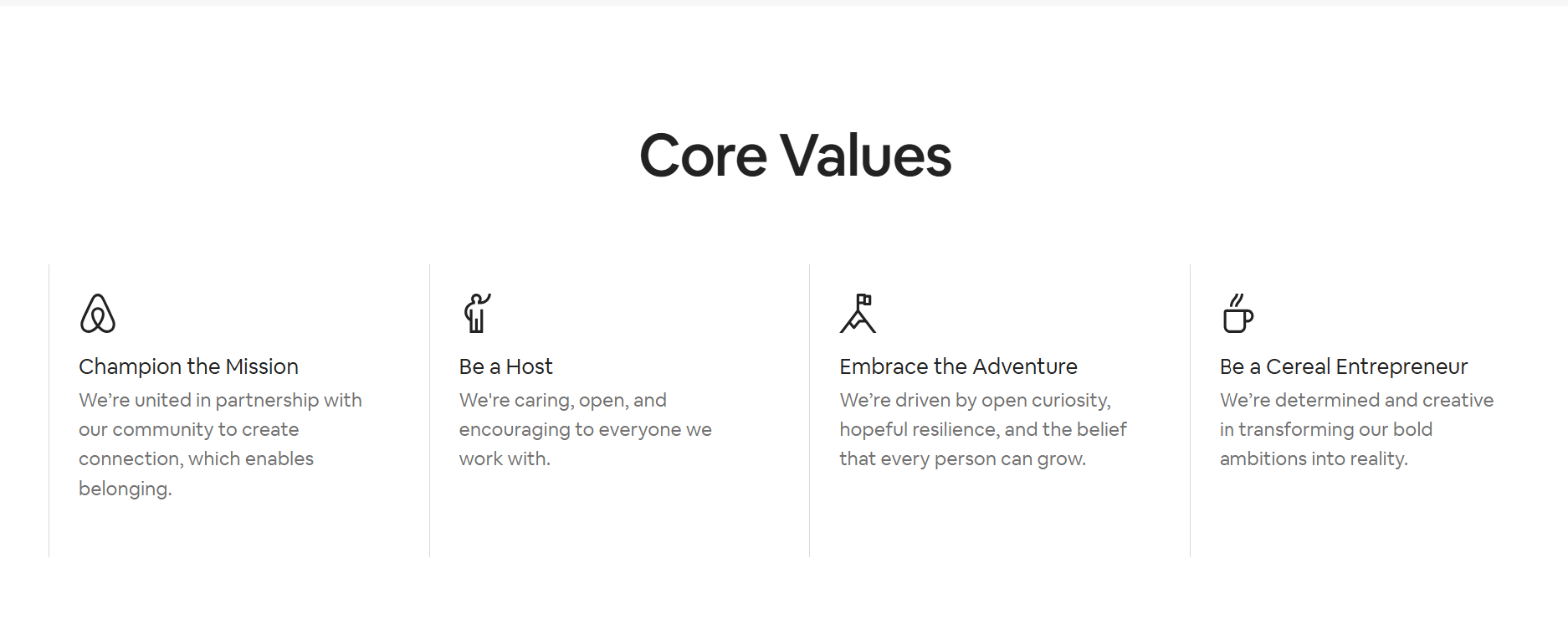
Airbnb offers another clear model of turning values into concrete habits. Their careers page highlights core values like "Be a Host," "Embrace the Adventure," and "Be a Cereal Entrepreneur," accompanied by explicit descriptions of the behaviors tied to each.
The key takeaway isn't to copy these exact values, but to model how an organization translates abstract ideas into actionable principles that employees can recognize and replicate.
Ready to put this into practice?
How Branded Materials Reinforce Your Internal Branding Every Day?
Every touchpoint within your organization communicates something, and your branded content assets are no exception.
Inconsistent presentations and documentation weaken internal trust in your brand, demonstrating that a focus on detail is essential not only for external clients, but equally so for your internal clients: your employees.
Why Inconsistent Slides and Templates Undermine Your Internal Brand?
Few things destroy the credibility of a branding strategy faster than visual inconsistency in internal communications.
When departments build their own materials using random fonts, off-brand color palettes, or distorted logos, the organization sends an implicit signal of disorganization and lack of rigor.
This fragmentation impacts business operations on three levels:
- Message Confusion: Uncoordinated graphics and imagery make key data harder to digest, creating friction in internal communication.
- Loss of Leadership Authority: Presenting strategic reports or quarterly results with poorly formatted slides diminishes the impact of the presenter, especially at the executive level.
- Productivity Loss: Employees waste valuable hours trying to "fix formatting" on slides rather than focusing on high-value strategy and content. We call this the “hidden cost of presentation design.”
To explore the strategic value of visual consistency, check out our guide on why brand identity matters in presentations.
How Custom Presentation Templates Build Internal Brand Equity?
If your team lacks dedicated design resources, standardized templates are your best tool for maintaining visual consistency across decks.
Corporate presentation templates and master slides serve as a standardized baseline that enables any employee—regardless of design skills—to build brand-aligned documents in minutes.
As an additional strategy, we recommend building a shared asset library. This delivers major operational benefits:
- A Unified Baseline: All teams (Sales, Finance, HR, Ops) utilize the same slide structures, icons, and approved color palettes.
- Streamlined Communication: Teams dramatically reduce time spent creating files.
- Cultural Pride: Employees feel proud presenting polished, professional, and visually compelling decks.
You can start standardizing your company's assets today by downloading our brand identity presentation template. You can thank us later!
What Your Internal Documents Say About Your Brand?
It’s vital to recognize that every document circulating inside your company acts as a cultural touchpoint. A technical report, an internal project proposal, or an onboarding presentation for a new hire sends clear signals about your organization's standards.
Design isn't mere decoration; design is operational clarity. A cleanly structured presentation demonstrates respect for the viewer's time, facilitates data-driven decision-making, and reflects a culture committed to excellence.
If your current internal assets feel outdated or inconsistent, 24Slides can help you redesign and standardize your company's slide library, ensuring every deck reflects the true strength of your brand.
Make Every Important
Presentation Count.
Get reliable, brand-trained design capacity whenever you need it. Never let internal bottlenecks ruin a high-stakes pitch.
Discover 24Slides ➝
Frequently Asked Questions (FAQ)
What is the main goal of Internal Branding?
The main goal is to help employees thoroughly understand and embody company values and purpose so they can act consistently with them every day. When achieved, culture stabilizes, expectations align, and external brand perception naturally strengthens.
What is the difference between Internal Branding and Employer Branding?
Internal branding focuses on how existing employees understand and live company values in their day-to-day work. Employer branding focuses on the company’s reputation as an employer, aimed both at retaining internal talent and attracting external candidates in the job market.
Who is responsible for Internal Branding?
Responsibility is shared among Executive Leadership, People & Culture (HR), and Internal Communications teams. Executive leaders bear the most visible responsibility, as their daily behavior sets the baseline benchmark for the entire organization.
How does Internal Branding impact Employee Engagement?
Internal branding acts as a primary catalyst for engagement: it provides the purpose, clarity, and recognition employees need to feel emotionally connected to their work.
According to academic research and Gallup data, actively living organizational values and participating in recognition programs are leading drivers of engagement, while clear role expectations increase the likelihood of engagement up to fourfold.
How do you measure Internal Branding success?
You can track employee pulse survey scores, intranet engagement analytics, participation rates in brand initiatives, and voluntary turnover rates over time. Brief quarterly surveys are usually sufficient to monitor whether cultural alignment is trending up or down.
What should be included in an Internal Branding Checklist?
Start with plain-language core values, a clear list of observable behaviors tied to each value, consistent communication templates, leadership talking points, and a continuous feedback loop (such as a monthly pulse survey).
If you found this content valuable, explore more insights here: