What Is Brand Association? Definition, Examples, and How to Build It

Brand association is the deep mental connection, emotion, or attribute a consumer automatically links to your company. While brand awareness simply means people know you exist, brand association dictates how they feel about you.
TL;DR: Executive Summary
- Brand Association vs. Brand Awareness: Awareness means your target audience knows you exist. Association dictates exactly what they think and feel when they remember you.
- Why Brand Association Matters: Strong mental links act as your ultimate competitive advantage, directly driving customer loyalty, market differentiation, and premium pricing.
- The Main Types of Brand Association: Consumers connect with your corporate identity through five primary channels: functional attributes, emotional benefits, brand personality, visual cues, and cultural values.
- The Cost of Inconsistent Branding: Every off-brand sales pitch or "Frankenstein" slide deck actively dilutes your hard-earned brand equity and creates conflicting customer perceptions.
- How to Build a Brand Association Map: Put your brand at the center of a diagram and place the strongest customer emotions in the closest rings to uncover your true market reputation.
- Scaling Visual Consistency in Presentations: Enterprise teams rely on brand-trained professional designers to ensure every high-stakes presentation remains clear, credible, and flawlessly on-brand.
What is brand association?
Brand association is the specific mental connection a person makes between a company and a concept, emotion, or attribute.
These mental links are not formed overnight. They are the result of repeated, consistent interactions over time. This includes viewing a global advertising campaign, experiencing a product firsthand, or sitting through a high-stakes B2B sales presentation.
Associations can be overwhelmingly positive or deeply negative, and they generally function across three primary levels:
- Functional: What the product actually does (e.g., fast, durable, cloud-based).
- Emotional: How the brand makes them feel (e.g., safe, confident, relieved).
- Symbolic: What using the brand says about them to others (e.g., premium, innovative, eco-conscious).
Consider Apple. When most people think of Apple today, the immediate mental link is premium design and a seamless user experience. That connection is not an accident; it is the result of decades of deliberate, consistent brand association embedded into every touchpoint of their business.
Brand association vs. brand awareness
Brand awareness asks if a customer recognizes your name. Brand association asks what they think and feel when they hear it.
While marketing teams often use these terms interchangeably, they describe two completely different stages of the customer journey. Awareness measures basic recognition and recall. Association measures the specific thoughts, feelings, and attributes connected to your name.
It is entirely possible to have massive brand awareness without strong or positive brand associations. For example, a budget airline might have incredibly high brand awareness because of a recent viral news story about lost luggage. Everyone knows their name, but the mental connections are cheap, unreliable, and frustrating.
In business-critical environments, having high awareness means nothing if your audience associates your brand with sloppy execution or poor quality.
Why is brand association important?
In a crowded market, products are easily replicated, but mental connections are not. Brand association is important because it dictates how consumers perceive your value, which directly influences their purchasing behavior.
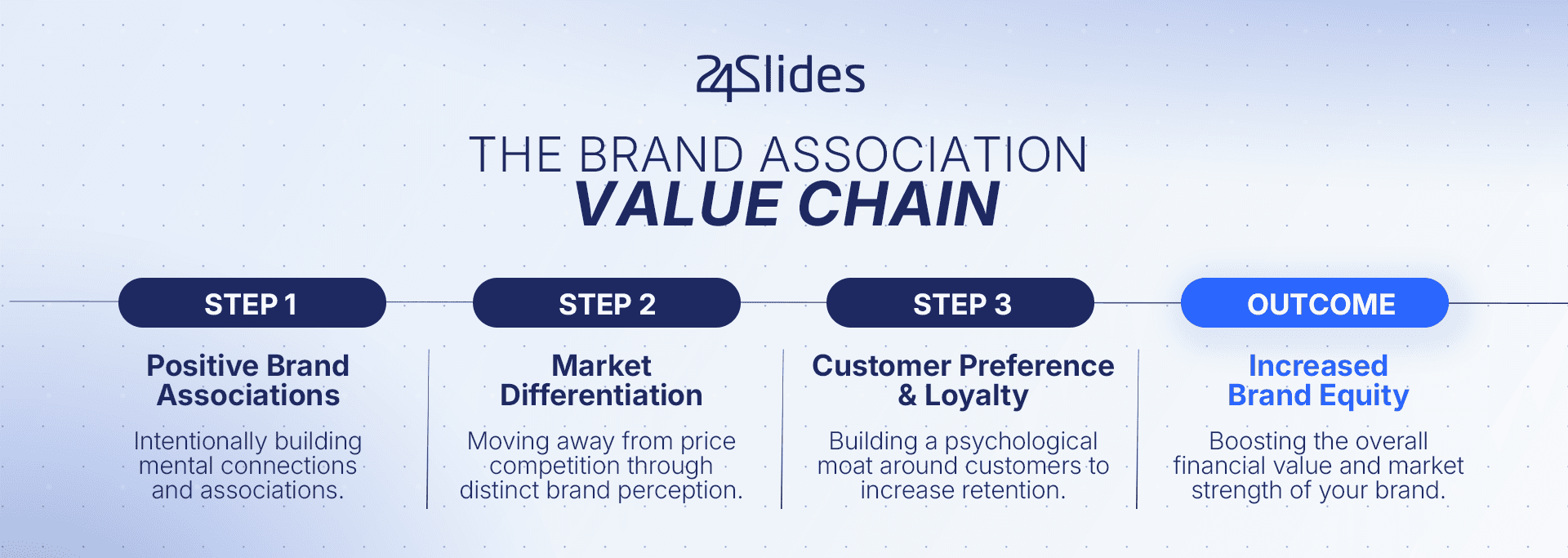
When you intentionally build positive brand associations, you unlock three major business advantages:
- Stronger Differentiation: If your software has the exact same features as a competitor, but your brand is associated with "enterprise security" while theirs is associated with "budget-friendly," you are no longer competing on price. You have differentiated your position.
- Customer Preference and Loyalty: People naturally gravitate toward brands that reflect their own self-image or solve their emotional pain points. Strong positive associations build a psychological moat around your customers, increasing retention and loyalty.
- Increased Brand Equity: When strong, consistent associations translate into customer loyalty, the overall financial value of your brand rises, directly increasing your brand equity.
What are the main types of brand association?
A cohesive brand identity is built by layering different types of associations together. Here are the six main ways consumers form mental links with your company:
Summary Table: Brand Association Types and Real-World Examples
| ASSOCIATION | WHAT IT CONNECTS | REAL EXAMPLE |
|---|---|---|
|
Product & Attribute |
Specific physical characteristics, technical specifications, or hardware performance. | Apple: Premium industrial design and secure, integrated ecosystems. |
| Benefit | Functional, emotional, or experiential rewards delivered to the customer. | Asana: Eliminating operational chaos and restoring workday clarity. |
| Brand Personality | Distinct human traits, tone of voice, and behavioral style assigned to the company. | Duolingo: Playful, persistent, and unconventional social voice. |
| Visual Cues | Logos, brand color palettes, typography, imagery style, and presentation layouts. | Coca-Cola: Signature red color palette and iconic Spencerian script. |
|
Values & Cultural |
Alignment with broader societal beliefs, ethical stances, or lifestyle philosophies. | Patagonia: Environmental activist ethos and sustainable manufacturing. |
|
People & Partnerships |
Borrowed authority gained through founders, executives, co-branding, or co-selling. | Microsoft Partners: Smaller B2B firms borrowing enterprise credibility through official co-marketing. |
Product and attribute associations
This is the most direct form of association. It links your brand to specific physical characteristics, features, or performance metrics.
Returning to our earlier example, Apple has spent decades highlighting sleek hardware and a closed, secure ecosystem to ensure its primary attribute association is premium innovation and high-quality performance.
Benefit associations
Consumers do not just buy features; they buy outcomes. Benefit associations connect your brand to specific functional, emotional, or experiential rewards.
For instance, the project management tool Asana deliberately builds benefit associations around "eliminating operational chaos" (functional) and "feeling in control of your workday" (emotional).
Brand personality associations
We often assign human traits to corporate entities. Is your brand bold and disruptive, or traditional and reliable? Is it playful or premium? Duolingo, for example, has cultivated a highly playful, persistent, and slightly mischievous personality. This sets it apart from other educational platforms that rely on dry, academic tones.
Visual brand associations
Visual cues are often the fastest way to trigger a mental connection. This includes your logo, corporate colors, typography, imagery, and overall design layout. Think of Coca-Cola; you only need to see their specific shade of red and script typography to instantly recognize the brand.
However, visual associations require strict repetition to work.
Maintaining visual consistency across all marketing assets and pitch decks is exactly how you establish a strong brand identity in presentations.
Values and cultural associations
Modern consumers and enterprise buyers increasingly want to align with companies that share their worldview. This type of association connects your brand to broader cultural beliefs, lifestyles, or social causes. Patagonia is the ultimate example here, as its entire brand is intrinsically associated with environmental sustainability and outdoor conservation.
People, partnerships, and endorsements
Brands frequently borrow equity from other entities. A brand can absorb the associations of a famous CEO, a celebrity ambassador, or a strategic partnership. When a boutique B2B consulting firm announces a formal partnership with a massive tech giant like Microsoft, the smaller firm instantly absorbs an association of enterprise-level credibility and trust.
Why inconsistent branding weakens brand association
As we established, brand association is the mental meaning attached to your company, while brand awareness is simply recognition. You can build the strongest corporate identity in the world, but if your execution is erratic, those mental links will fracture. Every time your company interacts with a client, you are either reinforcing your brand or actively diluting it.
When a company presents inconsistent touchpoints (such as a sleek website followed by a messy, poorly formatted sales deck), it creates cognitive dissonance. The premium association you wanted to build is instantly replaced with feelings of confusion or unprofessionalism.
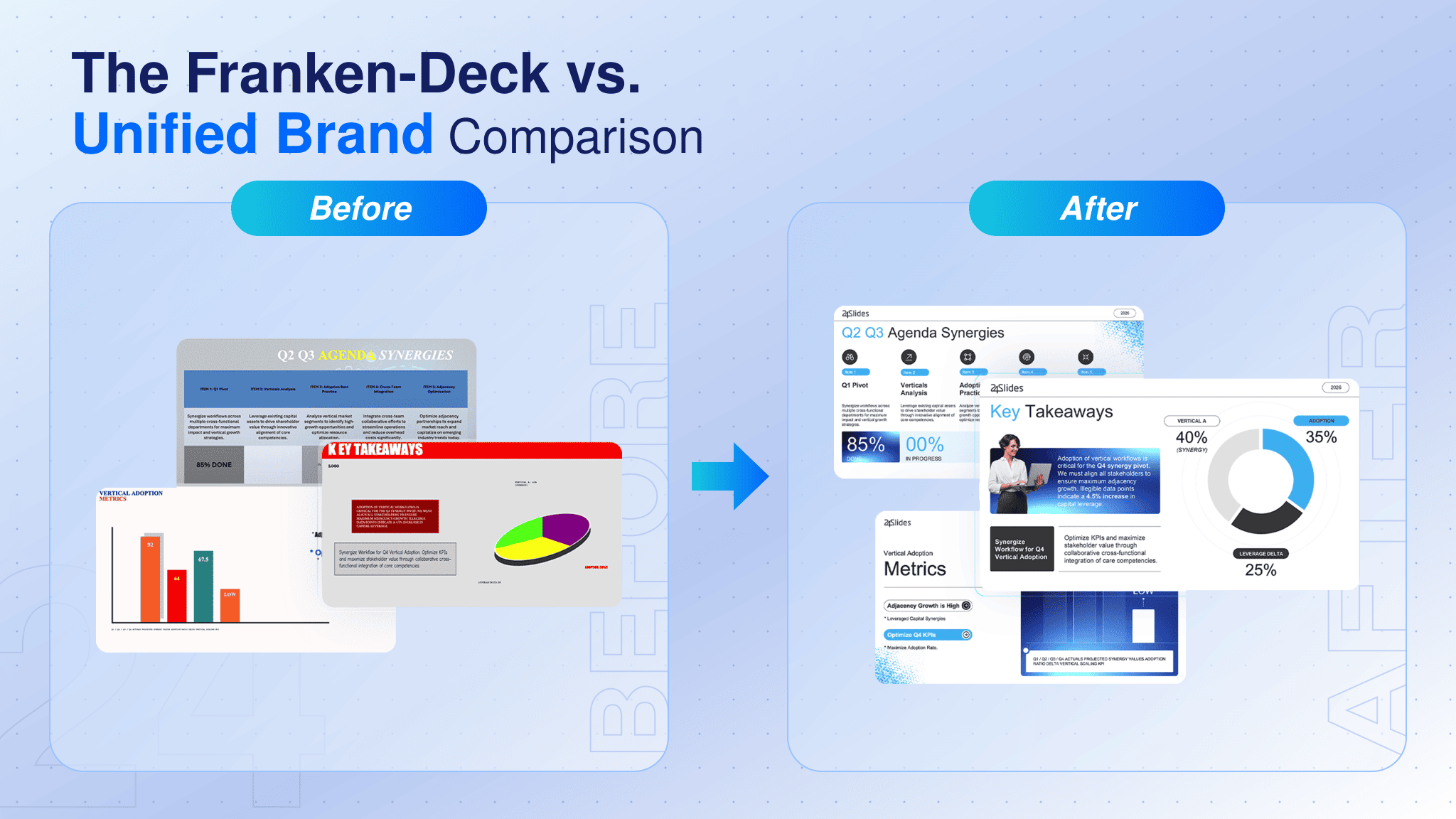
Presentations are one of the most frequent, high-stakes brand touchpoints in B2B environments. If your sales team is constantly presenting a disjointed "Franken deck" patched together from old slides, it actively damages your brand equity. To ensure these mental shortcuts remain strong and positive, maintaining strict brand consistency is key.
Every visual asset must tell the exact same story. (Note: You can also read our guide on how to fix a Franken deck to prevent these conflicting signals).
How to build strong brand associations
Building mental links in your customer's mind requires deliberate, strategic repetition. To move beyond a simple brand association definition, marketing teams must actively manage their corporate narrative using a continuous five-step process:
- Define: Clearly outline the specific functional and emotional associations your brand wants to own.
- Research: Survey your audience to uncover their existing perceptions of your company and recurring associations.
- Identify: Find the gaps between your intended messaging and actual market reality.
- Reinforce: Systematically inject your chosen associations across every repeated brand touchpoint.
- Review: Periodically audit your associations as markets and competitors evolve.
Create a brand association map
To visualize the gap between intention and reality, enterprise marketers use a brand association map.
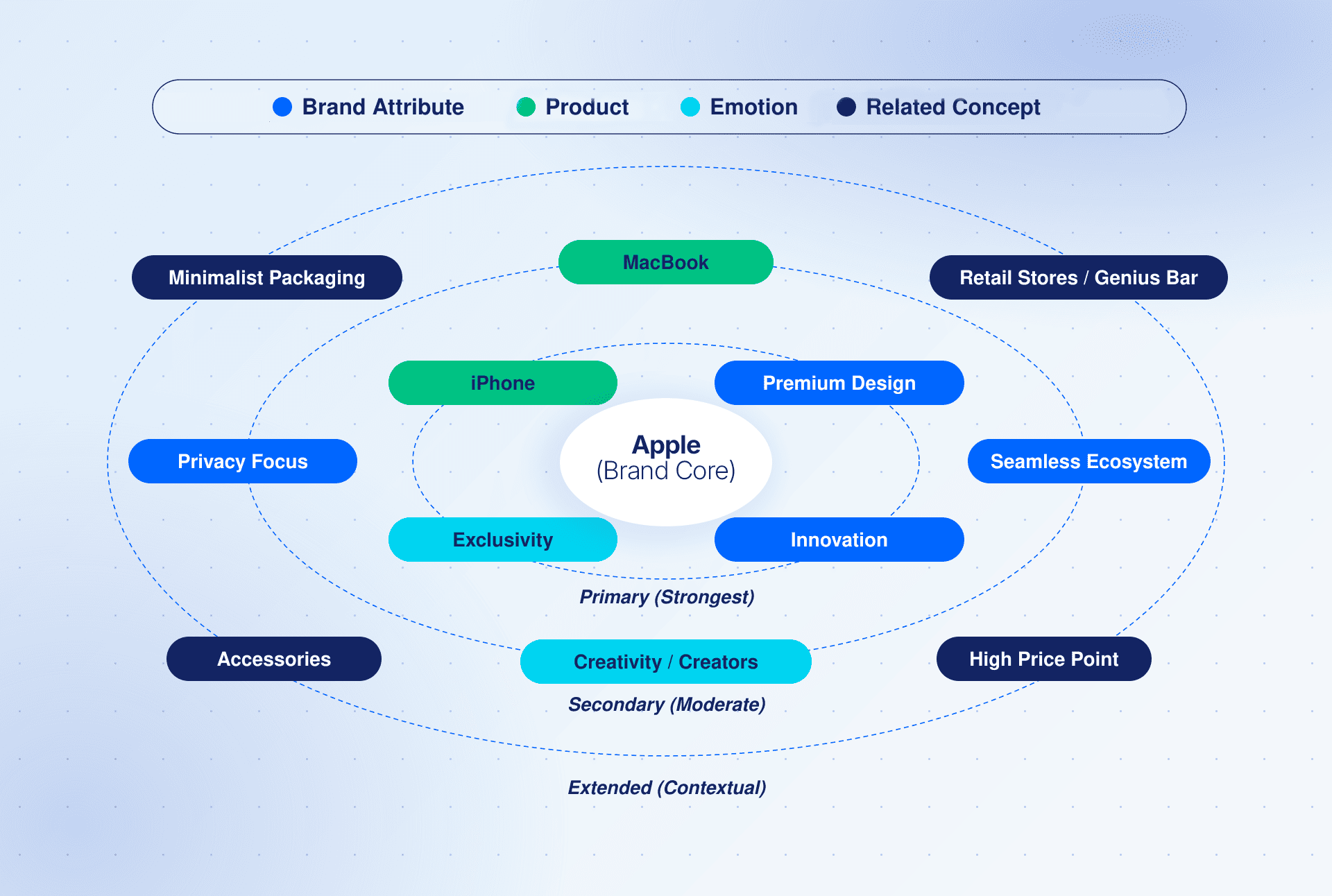
Imagine a web diagram with your brand placed directly at the center. Branching out from the center are nodes representing different attributes, emotions, benefits, and related concepts. The closer a node is to the center, the stronger the mental association. Mapping your brand visually allows you to compare the intended associations your marketing team wants against the actual perceptions your audience currently holds.
Apple Brand Association Map
This visual model maps the psychological distance between the core brand and how consumers perceive it.
Choose associations that are distinctive
We explored several positive brand association examples earlier, but to make them work for your company, they must be distinct. If your software company wants to be associated with quality and efficiency, you will struggle to stand out because every competitor in your category claims those exact same generic attributes.
To build a memorable brand, you must prioritize distinctive associations that competitors cannot easily claim. The most powerful brands achieve this by combining a functional product attribute with an unexpected emotional association, finding white space in the market.
Reinforce associations through visual consistency
Once you have defined your distinctive map, you must enforce it visually. Consistently applying the same corporate colors, typography, imagery, and layouts trains the audience to recognize you instantly.
Because presentations are one of the most frequent visual touchpoints in B2B communication, you must extend these strict guidelines to your slides. Using a locked-down brand identity presentation template is one of the most effective ways to reduce rogue, inconsistent execution across different departments.
How presentations can strengthen brand association
Transitioning from high-level marketing theory to daily business execution requires focusing on your most frequent touchpoints. In the corporate world, presentations are recurring visual brand touchpoints.
Every time your team opens PowerPoint or Google Slides, they have an opportunity to reinforce your corporate identity. Sales decks do more than just deliver pricing; they communicate both your core message and your brand personality to enterprise prospects. Internal strategy decks influence how your own employees perceive and represent the brand to the outside world.
Consistent slide design reinforces familiar visual associations. However, as organizations scale, maintaining this consistency becomes difficult. While providing a locked-down brand identity presentation template helps reduce inconsistent design across teams, templates alone cannot solve presentation bottlenecks.
Across Every Slide
See how leading organizations translate
corporate brand identity into polished slide decks.
What brand consistency looks like in presentations
Building a premium presentation is not about making slides look pretty. It is about making them look unified. To ensure your decks reflect values that you want to be associated with, your organization must strictly enforce the following rules:
- Consistent logo placement: Your logo should sit in the exact same position with the exact same clear space on every slide.
- Approved typography: Never allow system default fonts. Apply approved corporate typography across every single slide to maintain a professional tone.
- Correct color palettes: Limit color choices strictly to your primary and secondary brand guidelines.
- Personality-matching imagery: Use photography and illustrations that align with your brand personality. If you are a serious financial firm, do not use playful, cartoonish icons.
- Visual hierarchy: Keep layouts recognizable so the audience knows exactly where to look for key data.
- Cross-format consistency: Maintain this exact consistency across different presentation types, whether it is a massive keynote or a routine internal update.
If you need inspiration on how top-tier companies execute this, you can get inspired by the 7 best branded presentation examples we've seen.
Brand association examples from recognizable brands
To truly master this concept, it helps to look at how global leaders engineer their mental shortcuts. Notice how each of these companies uses a completely different mechanism to secure their position in the market:
Nike: Performance and Athletic Excellence
Nike does not just sell shoes; they sell the concept of athletic greatness. The mechanism they use to build this is endorsement and emotional branding. By consistently partnering with elite athletes and using empowering messaging, Nike successfully transfers the association of "champion" directly onto their apparel.
Volvo: Supreme Safety
While other luxury car brands battle over speed or aesthetics, Volvo completely owns the association of safety. The mechanism here is product innovation and corporate values. By consistently centering their PR, engineering, and advertising around passenger safety, they built an unbreakable mental link with careful, family-oriented drivers.
Patagonia: Environmental Activism
Patagonia is the gold standard for values-based association. Their mechanism is corporate transparency and activism. Through campaigns that encouraged recycling and donated company profits to climate initiatives, they built an ironclad association with environmental conservation. Consumers buy Patagonia because wearing it signals their own eco-conscious values to the world.
24Slides: Enterprise Reliability in Presentations
In the B2B sector, consistent service delivery drives brand association. Global enterprise teams associate 24Slides with absolute reliability and flawless visual execution. Our mechanism is managed operational consistency. By providing dedicated, brand-trained designers and priority 10-hour turnarounds, we ensure executives experience total peace of mind and project instant authority in every presentation.
Why use 24Slides for branded presentations?
Many enterprise organizations struggle with visual identity not because they lack software, but because they force subject matter experts to act as slide designers.
24Slides provides the exact infrastructure you need to scale your brand identity across your most important communications:
- Designers use your existing guidelines: We work directly from your established corporate guidelines to ensure strict compliance with your visual identity.
- Brand-trained dedicated teams: We do not rely on a rotating pool of anonymous freelancers. Your dedicated team learns your specific design preferences to ensure your slides perfectly reflect the core values you want associated with your brand.
- Scalable support: Access reliable capacity for recurring presentation work without adding internal headcount.
- Fast turnaround: We support teams with frequent presentation needs by offering reliable standard delivery alongside priority 10 hour turnarounds.
- Editable files: Your final slides remain fully editable in PowerPoint or Google Slides after professional design.
Partnering with a dedicated design team ensures your corporate narrative is always clear, credible, and flawlessly executed.
Presentation Count.
Get reliable, brand-trained design capacity whenever you need it.
Never let internal bottlenecks ruin a high-stakes pitch.
Frequently asked questions
What is brand association?
It is the immediate mental connection a person makes between a specific company and a feeling, concept, or attribute. It essentially dictates your overall corporate reputation.
What is a brand association map?
It is a visual diagram used by marketers to map the psychological distance between a brand and specific consumer perceptions. Attributes that are strongly associated with the brand are placed in the inner ring, while weaker or contextual associations are placed in the outer rings.
How do you build positive brand associations?
You build them through strategic repetition. You must first define the specific functional and emotional traits you want to own. Then, you must enforce strict visual and operational consistency across every single customer touchpoint.
What is the difference between brand association and brand awareness?
Brand awareness measures visibility, answering the question of whether a consumer recognizes your name. Brand association measures reputation, answering the question of what specific thoughts and feelings arise when they actually see your name.
Why is brand association important in marketing?
It is the ultimate driver of brand equity. Positive associations allow companies to differentiate themselves from competitors, build deep customer loyalty, and ultimately charge premium prices for their products and services.
Explore our expert guides on brand execution and presentation strategy: